Jason Lazarus: Too Hard to Keep (Syracuse)
April 4 – May 31, 2013
Kathleen O. Ellis Gallery
Gallery Talk: Thursday, April 4, 5pm
Reception: Thursday, April 4, 5-7pm
In 2010 Chicago-based artist Jason Lazarus initiated a living archive of photos deemed “too hard to keep.”
Too Hard to Keep is a place for photographs, photo albums, photo-objects, and even digital files to exist when they are too difficult to hold on to, yet too meaningful to destroy. Participants have dictated whether the photographs submitted to the archive may be shown freely with other pieces of the archive, or if they are only to be displayed face down, adding to the charged significance of individual objects.
With the exhibition Too Hard to Keep (Syracuse) Lazarus shares a slice of the larger archive and invites anonymous local submissions in a carefully considered installation at Light Work.
—
Shane Lavalette: The idea of being the one responsible for all things “too hard to keep” seems daunting! What compelled you to start this archive?
Jason Lazarus: First, it needed to happen; I am the type of person who would participate in this project! Second, over the past few years I have been increasingly been interested in the vernacular—collecting, editing, curating images for additional meaning as I encounter them. For me it’s as urgent and compelling as making my own original image with a camera, and my photographic practice simultaneously embraces both these days.
This project, once conceived, grew organically as I reached out to my immediate network, and the earnestness of the submissions invigorates the labor and care needed to administer them.
SL: This ‘earnestness’ is palpable in viewing the archive. One can feel it. I’m always amazed at how over the course of an image’s life, our feelings toward it can shift from joy, to anger, indifference, or deep sadness. Of course it’s different for every circumstance, but how would you characterize this overwhelming need to part with an object, and more specifically, a photograph?
JL: One note about the presentation strategy: I want the viewer to feel my relationship to the images as well—that this is not a distanced, museumological, and sterile archive but an artist-run project that has a feeling and imperfect hand guiding the materials. Regarding parting with things, we’re always an amalgam of our past, the present, and our idea of our future—objects come and go as we need them. Letting go of photographs is more about the future than the past…
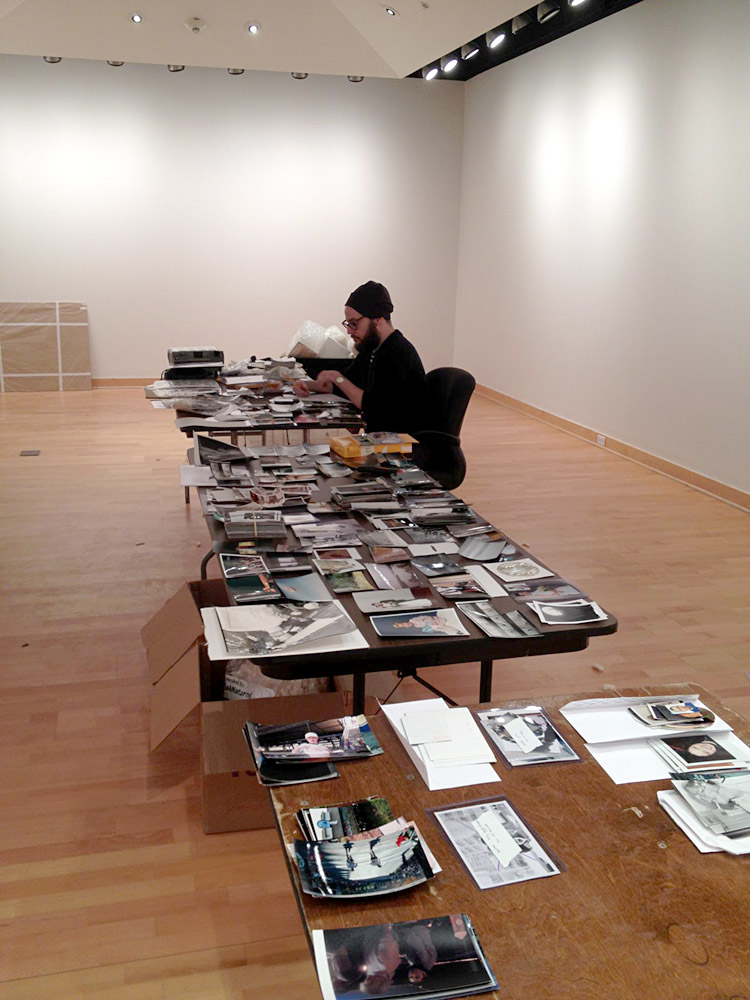
Jason Lazarus: Too Hard to Keep (Syracuse) at Light Work
SL: Do you find yourself conflicted when installing such personal items in the context of an art exhibition?
JL: No, I’m more conflicted with how to create strategies to relay the tension of each entry. Sometimes installation strategies can undermine the whole project, and other times they underscore the epic qualities innate to the archive
SL: I love the fact that you’ve allowed certain images or objects to be exhibited but concealed at the request of the former owner—in the case of photographic prints, by just showing the backs of them. How do you see these in conversation with the other images?
JL: The images submitted as private and therefore exhibited face down are vital—they say as much about the owners (and the rest of us) as the most potent images we get to see. Quietly, and still visually, they have much to say. They are activated by the public images, and vice versa. The audience is asked to consider them as placeholders, as open narrative, as truly charged and thus, in a way, dangerous.
SL: Charged? Dangerous? Interesting use of words… Can you elaborate?
JL: They are symbolic of our own worst fears… they can be projected upon without limit.
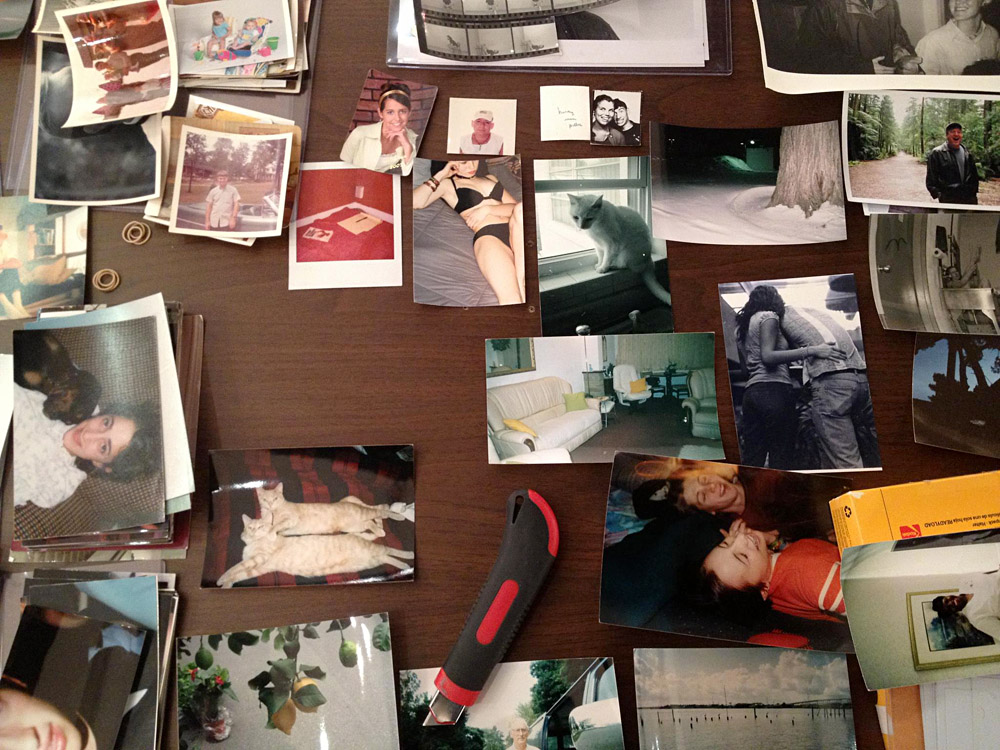
Jason Lazarus: Too Hard to Keep (Syracuse) at Light Work
SL: How would you describe the themes that arise in the archive? Do you find patterns, oddities, clichés?
JL: Yes, they couch everything from singularity to cliché as any large group of vernacular images might. Their unifying thread in this archive, the fact that they are “too hard to keep,” folds the familiar patterns and tropes of the private vernacular into a refreshed tension—they are taut…
SL: What have you found to be the most moving submissions? Is there one in particular that continues to strike you?
JL: My relationship with the archive and all of its contents is always in flux. Landscapes in the archive can be phenomenally powerful. To have an outdoor expanse implicated is for me fascinating and I can relate to this sometimes more easily than an image of a person who I don’t know. The private images are always moving to me when installed. They are obstinate, they refuse to bore the viewer with content, they are completely elemental in this project—all charge, no window.
SL: I’m glad you touched on this. There are certain images which may be hard for some viewers to imagine why they are “too hard to keep”—a landscape, a building, an abstraction. I find these to be the most powerful…
JL: Yes, there is a sort of slow violence about the most static images.
SL: You recently opened the archive up to digital submissions, and even offered your personal cell phone number for anyone to anonymously text images to you. In what way are these submissions different than the physical ones?
JL: I’m not sure yet, as I’ve only been receiving digital submissions for a relatively short period of time. Certainly I miss the objecthood of these entries, and the stories the photos-as-objects may have can’t be immediately seen (yellowing, wear and tear, handwriting, etc). On the other hand, receiving them unexpectedly on my phone, in the middle of a normal day, out of thin air, is poetically very rewarding. Someone’s personal narrative literally interrupts mine. It’s an unexpected shock, a signal, a moment of camaraderie…
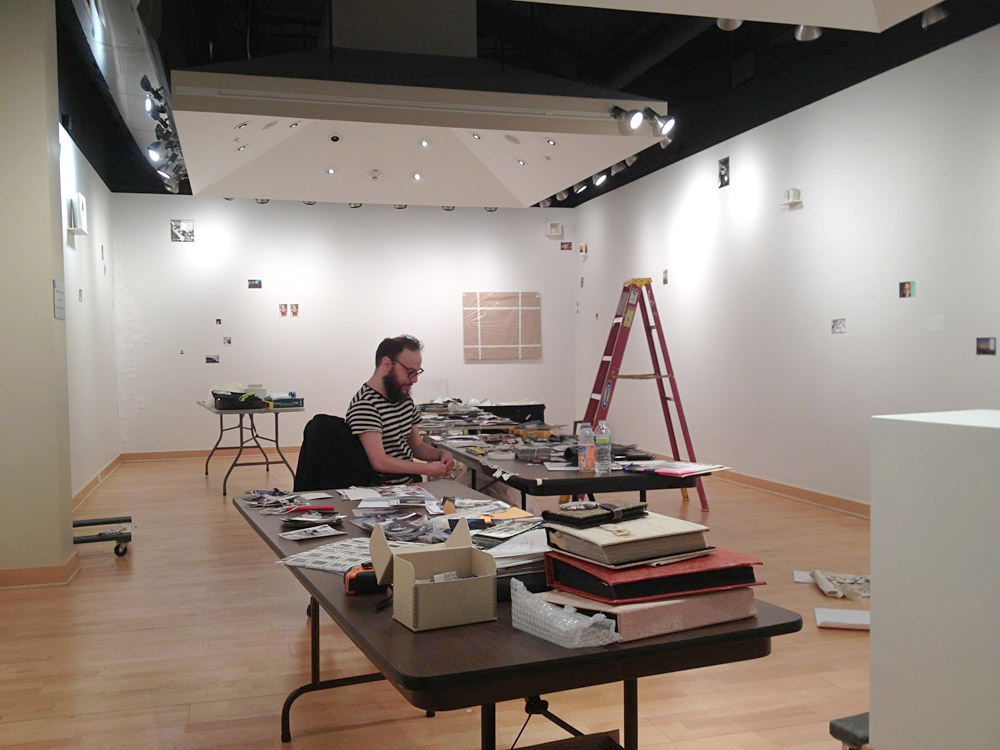
Jason Lazarus: Too Hard to Keep (Syracuse) at Light Work
SL: This makes me wonder… How do you view our relationship to, say, ‘photo albums’ on Facebook to the dusty ones in the closet? Can we have the same sentimentality or pain result from a digital file as a photographic print?
JL: It’s not for me to say. I feel lucky to be living at a time when one image paradigm is leading to another, and I can actively question both from a sense of heightened awareness and perspective.
Now that personal photos are digitized, it’s interesting to watch them, like water, effortlessly find their way quickly into new crevices and reservoirs far from their original source.
SL: What is your process of engaging with a local community, for example Syracuse?
JL: When possible, I will make myself available to a community for one day of personal pickups. I’ll dedicate 8-10 hours of being on call so community members can submit to the project in person without much effort on their part. Going to where the photos live is, for me, a unique and rare opportunity to understand their history and context better, even if the eventual audience is not privy to this information. It helps me become a better curator and artist within the archive’s parameters.
SL: Do you see an end in sight, or is the Too Hard to Keep archive a life-long commitment?
JL: T.H.T.K. is a life-long project, and I have found a colleague, Aron Gent of Chicago, to take it over in case something unexpected should happen to me. This way I can ensure some continuity to the archive and its format, as well as reciprocate the faith that the public has put into the project.
SL: With Too Hard to Keep (Syracuse) the site-specific installation of selected images and objects from the archive will also live on in publication form, as an issue of Contact Sheet. How will these images change when reproduced in the pages of the book? Who do you hope discovers this catalogue?
JL: I’m not sure actually, as the project hasn’t been published yet. I have instincts about what may happen, but it’s a puzzle—I’m interested in finding ways to keep the tension alive and complex when the actual object is no longer at arms reach.
Unlike a lot of other contemporary image based work where you significantly benefit from having studied photographic history and theory, the audience for this project starts with everyone…
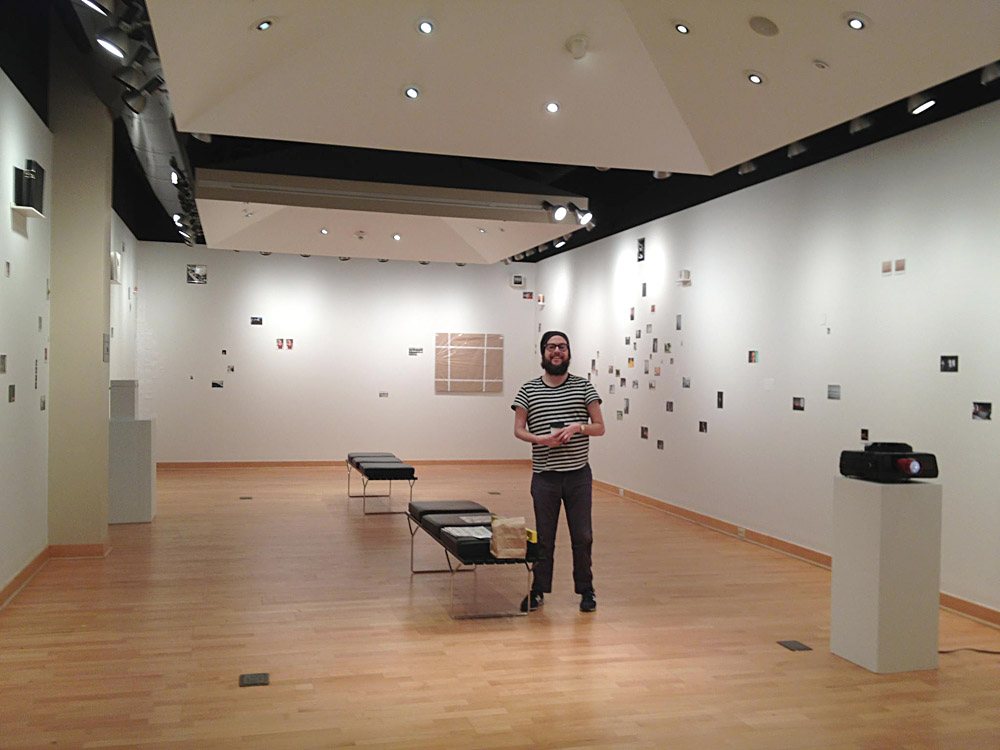
Jason Lazarus: Too Hard to Keep (Syracuse) at Light Work
—
Jason Lazarus is a Chicago-based artist, curator, writer, and educator who received his MFA in Photography from Columbia College Chicago in 2003. Lazarus has actively exhibited around the country and abroad while teaching photography at Columbia College and the School of the Art Institute of Chicago. Selected exhibition highlights include Black Is, Black Aint at the Renaissance Society, Chicago, IL; Image Search at PPOW Gallery, New York, NY; On the Scene at the Art Institute of Chicago, Chicago, IL; and solo exhibitions at Andrew Rafacz Gallery, Chicago, IL; the Museum of Contemporary Art, Chicago, IL; Kaune, Sudendorf, Cologne, Germany; and D3 Projects, Los Angeles, CA. Notable honors include the John Gutmann Photography Fellowship, 2010; an Illinois Arts Council Fellowship award, 2009; the Richard H. Driehaus Foundation Award, Emerging Artist, 2008; and the Emerging Artist Artadia Grant, 2006. His work can be found in the collections of the Art Institute of Chicago, the Museum of Contemporary Art Chicago, the Milwaukee Museum of Art, and the Bank of America LaSalle Photography collection, among many others. Lazarus is represented by Andrew Rafacz Gallery, Chicago, IL.
www.jasonlazarus.com
—
Interested in submitting to the T.H.T.K. archive?
Drop off your print anonymously in the drop box located at Light Work during the length of the exhibition. If you are not local, you can submit to the artist directly by following the instructions at toohardtokeep.blogspot.com

Light Work at the PPAC Book Fair, May 18, 12-6pm
/in EventsPlease join us for the 4th annual Philadelphia Photo Arts Center Book Fair which will feature a number of local and national artists, publishers, and publishing projects. This is Philadelphia’s annual opportunity to purchase some of the most innovative image-based publications being created today.
Partial list of participants:
Printed Matter
MACK Books
Conveyor Arts
Sun System Press
ICA Philadelphia
Bodega
Megawords
Light Work
Vox Populi
PhotoBookArts
Houseboat Press
Bryan Graf
Justin Kimball
Tom Young
Justin Audet
Dan Boardman
Lisa Kereszi
Dominic Episcopo
Stephanie Bursese
With titles available from:
Little Brown Mushroom
TBW Books
Spaces Corners / Ed Panar
Public Fiction
Daniel Shea
Brian Ulrich
+ more!
Find more information on the PPAC website.
Hank Willis Thomas on Light Work
/in From the FilesHank Willis Thomas
—
See a selection of Hank Willis Thomas’ work on his Light Work artist page.
Order a signed copy of Hank Willis Thomas’ book Pitch Blackness in the Light Work Shop.
A Conversation with Jason Lazarus
/in InterviewsIn 2010 Chicago-based artist Jason Lazarus initiated a living archive of photos deemed “too hard to keep.”
Too Hard to Keep is a place for photographs, photo albums, photo-objects, and even digital files to exist when they are too difficult to hold on to, yet too meaningful to destroy. Participants have dictated whether the photographs submitted to the archive may be shown freely with other pieces of the archive, or if they are only to be displayed face down, adding to the charged significance of individual objects.
With the exhibition Too Hard to Keep (Syracuse) Lazarus shares a slice of the larger archive and invites anonymous local submissions in a carefully considered installation at Light Work.
—
Shane Lavalette: The idea of being the one responsible for all things “too hard to keep” seems daunting! What compelled you to start this archive?
Jason Lazarus: First, it needed to happen; I am the type of person who would participate in this project! Second, over the past few years I have been increasingly been interested in the vernacular—collecting, editing, curating images for additional meaning as I encounter them. For me it’s as urgent and compelling as making my own original image with a camera, and my photographic practice simultaneously embraces both these days.
This project, once conceived, grew organically as I reached out to my immediate network, and the earnestness of the submissions invigorates the labor and care needed to administer them.
SL: This ‘earnestness’ is palpable in viewing the archive. One can feel it. I’m always amazed at how over the course of an image’s life, our feelings toward it can shift from joy, to anger, indifference, or deep sadness. Of course it’s different for every circumstance, but how would you characterize this overwhelming need to part with an object, and more specifically, a photograph?
JL: One note about the presentation strategy: I want the viewer to feel my relationship to the images as well—that this is not a distanced, museumological, and sterile archive but an artist-run project that has a feeling and imperfect hand guiding the materials. Regarding parting with things, we’re always an amalgam of our past, the present, and our idea of our future—objects come and go as we need them. Letting go of photographs is more about the future than the past…
Jason Lazarus: Too Hard to Keep (Syracuse) at Light Work
SL: Do you find yourself conflicted when installing such personal items in the context of an art exhibition?
JL: No, I’m more conflicted with how to create strategies to relay the tension of each entry. Sometimes installation strategies can undermine the whole project, and other times they underscore the epic qualities innate to the archive
SL: I love the fact that you’ve allowed certain images or objects to be exhibited but concealed at the request of the former owner—in the case of photographic prints, by just showing the backs of them. How do you see these in conversation with the other images?
JL: The images submitted as private and therefore exhibited face down are vital—they say as much about the owners (and the rest of us) as the most potent images we get to see. Quietly, and still visually, they have much to say. They are activated by the public images, and vice versa. The audience is asked to consider them as placeholders, as open narrative, as truly charged and thus, in a way, dangerous.
SL: Charged? Dangerous? Interesting use of words… Can you elaborate?
JL: They are symbolic of our own worst fears… they can be projected upon without limit.
Jason Lazarus: Too Hard to Keep (Syracuse) at Light Work
SL: How would you describe the themes that arise in the archive? Do you find patterns, oddities, clichés?
JL: Yes, they couch everything from singularity to cliché as any large group of vernacular images might. Their unifying thread in this archive, the fact that they are “too hard to keep,” folds the familiar patterns and tropes of the private vernacular into a refreshed tension—they are taut…
SL: What have you found to be the most moving submissions? Is there one in particular that continues to strike you?
JL: My relationship with the archive and all of its contents is always in flux. Landscapes in the archive can be phenomenally powerful. To have an outdoor expanse implicated is for me fascinating and I can relate to this sometimes more easily than an image of a person who I don’t know. The private images are always moving to me when installed. They are obstinate, they refuse to bore the viewer with content, they are completely elemental in this project—all charge, no window.
SL: I’m glad you touched on this. There are certain images which may be hard for some viewers to imagine why they are “too hard to keep”—a landscape, a building, an abstraction. I find these to be the most powerful…
JL: Yes, there is a sort of slow violence about the most static images.
SL: You recently opened the archive up to digital submissions, and even offered your personal cell phone number for anyone to anonymously text images to you. In what way are these submissions different than the physical ones?
JL: I’m not sure yet, as I’ve only been receiving digital submissions for a relatively short period of time. Certainly I miss the objecthood of these entries, and the stories the photos-as-objects may have can’t be immediately seen (yellowing, wear and tear, handwriting, etc). On the other hand, receiving them unexpectedly on my phone, in the middle of a normal day, out of thin air, is poetically very rewarding. Someone’s personal narrative literally interrupts mine. It’s an unexpected shock, a signal, a moment of camaraderie…
Jason Lazarus: Too Hard to Keep (Syracuse) at Light Work
SL: This makes me wonder… How do you view our relationship to, say, ‘photo albums’ on Facebook to the dusty ones in the closet? Can we have the same sentimentality or pain result from a digital file as a photographic print?
JL: It’s not for me to say. I feel lucky to be living at a time when one image paradigm is leading to another, and I can actively question both from a sense of heightened awareness and perspective.
Now that personal photos are digitized, it’s interesting to watch them, like water, effortlessly find their way quickly into new crevices and reservoirs far from their original source.
SL: What is your process of engaging with a local community, for example Syracuse?
JL: When possible, I will make myself available to a community for one day of personal pickups. I’ll dedicate 8-10 hours of being on call so community members can submit to the project in person without much effort on their part. Going to where the photos live is, for me, a unique and rare opportunity to understand their history and context better, even if the eventual audience is not privy to this information. It helps me become a better curator and artist within the archive’s parameters.
SL: Do you see an end in sight, or is the Too Hard to Keep archive a life-long commitment?
JL: T.H.T.K. is a life-long project, and I have found a colleague, Aron Gent of Chicago, to take it over in case something unexpected should happen to me. This way I can ensure some continuity to the archive and its format, as well as reciprocate the faith that the public has put into the project.
SL: With Too Hard to Keep (Syracuse) the site-specific installation of selected images and objects from the archive will also live on in publication form, as an issue of Contact Sheet. How will these images change when reproduced in the pages of the book? Who do you hope discovers this catalogue?
JL: I’m not sure actually, as the project hasn’t been published yet. I have instincts about what may happen, but it’s a puzzle—I’m interested in finding ways to keep the tension alive and complex when the actual object is no longer at arms reach.
Unlike a lot of other contemporary image based work where you significantly benefit from having studied photographic history and theory, the audience for this project starts with everyone…
Jason Lazarus: Too Hard to Keep (Syracuse) at Light Work
—
Jason Lazarus is a Chicago-based artist, curator, writer, and educator who received his MFA in Photography from Columbia College Chicago in 2003. Lazarus has actively exhibited around the country and abroad while teaching photography at Columbia College and the School of the Art Institute of Chicago. Selected exhibition highlights include Black Is, Black Aint at the Renaissance Society, Chicago, IL; Image Search at PPOW Gallery, New York, NY; On the Scene at the Art Institute of Chicago, Chicago, IL; and solo exhibitions at Andrew Rafacz Gallery, Chicago, IL; the Museum of Contemporary Art, Chicago, IL; Kaune, Sudendorf, Cologne, Germany; and D3 Projects, Los Angeles, CA. Notable honors include the John Gutmann Photography Fellowship, 2010; an Illinois Arts Council Fellowship award, 2009; the Richard H. Driehaus Foundation Award, Emerging Artist, 2008; and the Emerging Artist Artadia Grant, 2006. His work can be found in the collections of the Art Institute of Chicago, the Museum of Contemporary Art Chicago, the Milwaukee Museum of Art, and the Bank of America LaSalle Photography collection, among many others. Lazarus is represented by Andrew Rafacz Gallery, Chicago, IL.
www.jasonlazarus.com
—
Interested in submitting to the T.H.T.K. archive?
Drop off your print anonymously in the drop box located at Light Work during the length of the exhibition. If you are not local, you can submit to the artist directly by following the instructions at toohardtokeep.blogspot.com
Light Work’s New Identity
/in News, Studio VisitIn celebration of Light Work’s 40th anniversary we’re pleased to launch a new identity in conjunction with this brand new website!
More on the website soon. First, lets talk identity… Over the past months we’ve been working closely with Michael Dyer and the team at the Brooklyn-based design firm Remake to develop this new look for the organization — from the logo, to the typefaces, and the pages of Contact Sheet, Mike and his team have carefully developed a more current aesthetic for the oraganization. We couldn’t be happier with the result.
To kick things off, we thought it’d be nice to chat with Mike about the process of developing Light Work’s new identity and show some behind-the-scenes moments of the studio and the design process. Enjoy!
Remake studio, Brooklyn, NY
Shane Lavalette: Tell us about Remake and your approach to design.
Michael Dyer: I started Remake after many years of working for other studios in Washington DC and New York. Remake is intended to be a distillation of my approach to design, which is the reason I started the studio — to put principles directly into practice. Those principles grow out of a concern for the social responsibility of design, and a belief that anything one designs has to justify its existence by contributing to a qualitative improvement in the world. This may sound rather grand, but I really do see design as part of the production of culture.
Remake’s clients tend to often be from allied disciplines — architects, photographers, artists, galleries, museums, etc — although we work with plenty of corporations and businesspeople as well. Variety in clients and projects is important to me. That said, Remake specializes in two areas: corporate/brand identity, and printed publications (with a focus on books).
Remake studio, Brooklyn, NY
SL: Reinventing the identity of an organization is a challenging task, especially one as old as Light Work (this year marks our 40th year of supporting artists!). What was your approach in considering possible directions?
MD: In some ways the overall process that we employ for designing a visual identity is rather consistent, and has simply been developed/refined through experience. However, every project requires adjustments to this underlying process. Clients differ, communication objectives differ, audiences differ — all this has to be factored into the approach. But the basic methodology is a strong one and forms the backbone of our process which begins with in-depth discussions and identification of communication objectives, then progresses into exploration, development, refinement, and application of the design system.
When collaborating with Light Work, we had 40 years of history behind the conversations about where we were headed with the new identity. This provided a fantastic foundation on which to build. It also meant that we got a very concise explanation of what makes Light Work what it is, and its exceptionally unique and inspiring support of artists and their work. So we were very well equipped to judge the quality and efficacy of our work as it progressed from inception to application.
Light Work logo, 2013
SL: The new Light Work logo is minimal, geometric, modern, and is open to a variety of interpretations. How would you describe the ideas behind it?
MD: The new Light Work logo is comprised of two interlocking L shapes that suggest a shifting of perspective and a dialogue or synthesis between two- and three-dimensional form. (I say “suggest” because I think design is stronger when ideas are implied rather than when they are illustrated.) The square at its center represents light emanating from the surrounding form of a frame; it also suggests a view into or out of a space described by that same surrounding form. The square can also be read as representing the individual artist, supported by Light Work as the contextual structure around them.
The symbol being open to multiple viewpoints is, I think, critical to its success. People have to be able to invest a design with their own meaning to an extent. Designing things that are excessively didactic or literal is patronizing to the viewer and limits their ability to participate in the experience.
The new Light Work logo came after a long process of sketching, both by hand and on the computer. I’m a pretty loose sketcher, but there were a couple drawings that had a spark that would eventually lead to the solution, although it took a while for them to reveal themselves. In between, probably a couple hundred different designs were studied on the computer. Once the basic symbol had been designed it went through dozens of iterations. We considered the weight of the form, its compression, its color, how close or far apart the two L shapes were, etc. (And that’s even before we got into how it related to any typography.)
Light Work identity design process, Remake, Brooklyn, NY
SL: As designers, what is your approach to creating a lasting identity? What makes an organizations ‘look’ hold up for 10, 50, 100 years?
MD: 100 years is a tall order. But, yes, a constant concern in identity design, for me, is durability. I don’t endorse the cynical rapidity with which things sometimes change in the design world, especially in identity design where you are operating very near the heart of the institution or business. The process of designing an identity shouldn’t be one of prettifying or applying a cosmetic veneer — it should reach deep into the meaning and being of the organization and express something fundamental. It has to find a bit of the spirit of the organization, and that’s hard to do.
First, as a designer, I think you have to resist the urge to partake in superficial trends. Trends exist to expire. You are doing a client a tremendous disservice by using them as an excuse to participate in the Hot-New-Thing. Second, I think starting from a place of economy is best. Simple designs often endure, when they are carefully conceived and implemented. Third, I think the best work grows from a conceptual and formal synthesis — they are strong ideas expressed in powerful forms. Fourth, and most importantly, a designer has to listen to their client, carefully. This comes before all else. This is how you create something of substance that embodies fidelity to the spirit of the organization.
SL: The photographers and their work are always at the center of what Light Work does as an organization. How does design emphasize this?
MD: Yes, absolutely. Understanding the centrality of the photographers and their work was essential to developing the identity system, and the re-designed Contact Sheet and Light Work Annual as well. As I mentioned above, it’s even subtly referred to in the design of the new symbol itself.
We decided early on that the design system should be relatively quiet. It needed to be strong, it needed to be distinctive, but these did not preclude understatement. Details, always important, assumed an even greater weight. At all points we had to ensure that we were solving the communication problems, but in a manner that not only respected, but enhanced the presentation of the work. By addressing a range of design issues we were also creating a better overall setting within which the artists’ work could exist. In general, I feel the restraint and clarity of the new system is what allows the photographers’ work to really come through, take center stage, and shine.
Light Work identity design process, Remake, Brooklyn, NY
SL: In ‘Remaking’ (excuse the pun) the Contact Sheet, what were some of the biggest changes? What should subscribers be excited about?
MD: Well, the biggest changes have to do with pacing and rhythm. We have worked hard to create something that has a meaningful ebb and flow as a reader/viewer moves through the piece. Engineering a sensitive typographic system has a lot to do with this, as does the structure of the underlying grid on which the design is built. But it’s also about using space more efficiently and dramatically, and color as well, to a more limited extent. We wanted to create a more nuanced atmosphere; this is something that can be very powerful when handled with discernment.
And I feel this is what everyone should be most excited about: the artists’ work will continue to be varied and of exceptional quality; we are just fine-tuning the overall experience of absorbing, contemplating, and responding to that work within the Contact Sheet‘s pages. It’s been extremely exciting for me as well.
—
Subscribe to Contact Sheet to be sure to get the first newly designed issue. Arriving in mailboxes Summer 2013!
Apply for 2013 Light Work Grants in Photography
/in NewsThe Light Work Grants in Photography program was established in 1975 to support photographers in Central New York. The $2,000 grants are awarded to encourage the creation of new work. The work of the grant recipients is exhibited at Light Work and reproduced in Contact Sheet: The Light Work Annual.
Applicants must reside in the following counties to apply: Broome, Cayuga, Chemung, Chenango, Cortland, Herkimer, Jefferson, Lewis, Madison, Oneida, Onondaga, Oswego, Schuyler, Seneca, St. Lawrence, Tioga, or Tompkins.
This year the application process will be online. If you have any issues applying, please contact Light Work at info@lightwork.org
For more info or to apply visit http://lightwork.slideroom.com
DEADLINE: April 30, 2013
*NOTE: If you received a grant in 2008 or earlier you are eligible to re-apply this year. Full-time students are NOT eligible to apply.
Emily Vey Duke and Cooper Battersby present The Beauty is Relentless
/in Events, NewsThe literary post-punk short movies of Emily Vey Duke and Cooper Battersby have been tearing up the festival/gallery circuit for the past fifteen years with their blend of bedroom pop, perverse animations and hopes for fame. The Beauty is Relentless: The Short Movies of Emily Vey Duke and Cooper Battersby is a collection of award-winning scripts, creative writings and critical missives by scholars, video legends and animal experts – including Steve Reinke, Sarah Hollenberg, Akira Lippit, and Tom Sherman.
Praise for Emily Vey Duke and Cooper Battersby’s work:
[Here] exists a kind of nakedness, a peeling away of propriety, a questioning of behavioral and social systems – and yet I find their work refreshingly playful and deeply generous.
– Deborah Stratman, University of Illinois at Chicago
—
Cooper Battersby (b. 1971, Penticton British Columbia, Canada) and fellow Department of Transmedia faculty member Emily Vey Duke (b. 1972, Halifax Nova Scotia, Canada) have been working collaboratively since 1994. They work in printed matter, installation, curation and sound, but their primary practice is the production of single-channel video. Their work has been exhibited in galleries and at festivals in North and South America and throughout Europe, including the Walker Center (Minneapolis), The Banff Centre (Banff), The Vancouver Art Gallery (Vancouver), YYZ (Toronto), The New York Video Festival (NYC), The European Media Arts Festival (Osnabruck), Impakt (Utrecht) and The Images Festival (Toronto). Their tape Being Fucked Up (2000) has been awarded prizes from film festivals in Switzerland, Germany and the USA. Bad Ideas for Paradise (2002) was purchased for broadcast by the Canadian Broadcasting Corporation and for the libraries at Harvard and Princeton, and has won prizes from the NYExpo (NYC) and the Onion City festival (Chicago). I am a Conjuror (2004) has received prizes from the Ann Arbor Film Festival and the Onion City Festival.
www.dukeandbattersby.com
Susan Meiselas Lecture at Syracuse University
/in Events, NewsSusan Meiselas is an internationally known photographer and a member of Magnum Photos. She was made a MacArthur Fellow in 1992.Her coverage of the hostilities in Nicaragua earned her a medal for outstanding reportage from the Overseas Press Club in 1979. She has had one-woman shows in New York, London, and Paris. In 1982 she was named Photojournalist of the Year by the Association of Magazine Photographers and received the Leica Award for Excellence. She is the author of Carnival Strippers, Nicaragua: 1978-79, Kurdistan: In the Shadow of History, Pandora’s Box, Encounters with the Dani, and In History. She co-edited El Salvador: Work of Thirty Photographers and Chile from Within.
In addition to her work in photography, she served as assistant editor on Frederick Wiseman’s classic documentary film Basic Training. Her photographs and writings about Nicaragua were also the source for the television film Voyages by Marc Karlin. Meiselas studied anthropology at Sarah Lawrence and has an MA in visual education from Harvard University.
—
Light Work/Community Darkrooms, the Department of Transmedia Studies in the College of Visual and Performing Arts, and the S. I. Newhouse School of Public Communications’ department of Multimedia Photography and Design are pleased to present this lecture by renowned photographer Susan Meiselas. This lecture is sponsored through the Division of Student Affairs, Co-Curricular Fees.
A Closer Look: Book Collectors Offer
/in NewsTake advantage of the Book Collectors Offer and receive a signed book plus a subscription to Contact Sheet for only $75!
“A collection of color photographs shot in and around Tokyo. While Gossage’s trademark celebration of the banal is certainly on display here, the photographer charts new territory with shots of Tokyo street scenes, skyscapes and tissue boxes.”
– From the publisher
By any measure John Gossage is a non-conformist. He was thrown out of high school at sixteen, yet taught college at the graduate school level for close to twenty years. He was never formally trained as a graphic designer, yet has designed twelve of his own photography books, as well as numerous books for other artists. He grew up in a household where there was no art, no music, and no books, yet has amassed a personal library of thousands of photography books, curated dozens of photography exhibitions, and served as a consultant to art collectors and foundations around the world.
Order your copy of The Code with a one-year Contact Sheet subscription here.
2013 Light Work Student Invitational Exhibiton
/in NewsMark Hoelscher, Best of Show, 2013 Light Work Student Invitational
Congratulations to those students selected to be exhibited in the 2013 Light Work Student Invitational, as juried by Claire O’Neill (Editor, NPR’s The Picture Show):
View selected work from the exhibition and read Claire O’Neill’s statement online here.
Be sure to stop by Light Work to see the full selection of images!
2013 Light Work Student Invitational
March 1 – May 31, 2013
Reception: Thursday, April 4, 5-7pm
Light Work Hallway LCD Screen
Robert B. Menchel Media Center
316 Waverly Ave., Syracuse, NY
Announcing the 2013 Light Work Artists-in-Residence
/in NewsLight Work is pleased to announce the 2013 Light Work Artists-in-Residence!
Brijesh Patel
January 2013
Alexandra Demenkova
February 2013
George Gittoes
Mach 2013
John Freyer
March 2013
Jason Eskenazi
April 2013
Dani Levinthal
May / June 2013
Anouk Kruithof
May 2013
Karolina Karlic
June 2013
Cecil McDonald Jr.
July 2013
Matt Eich
July 2013
Jo Ann Walters
August 2013
Ofer Wolberger
August 2013
Eric Gottesman
November 2013
—
Applications are now open for 2014. Apply at http://lightwork.slideroom.com
A Closer Look: Shane Lavalette
/in NewsShane Lavalette‘s most recent body of work explores the relationship between traditional Southern music and the landscape of the South. Inspired by the sounds of old time, blues, and gospel music, his photographs are quiet and contemplative yet, as fellow photographer and poet Tim Davis describes, “build to a boisterous whole.” Through a playful series of portraits, still lifes, landscapes, and abstractions the artist delights in the musicality of the everyday life in the South. Lavalette’s photographs have been shown widely, including exhibitions at the High Museum of Art, Atlanta, GA; Center for Documentary Studies at Duke University, Durham, NC; Aperture Gallery, New York, NY; Montserrat College of Art, Beverly, MA; The Carpenter Center for Visual Arts at Harvard University, Cambridge, MA; The Center for Photography at Woodstock, Woodstock, NY; The Museum of Fine Arts, Boston, MA; Musee de l’Elysee, Lausanne, Switzerland, among others. His works are held in numerous private and public collections. Lavalette participated in Light Work’s Artist-in-Residence Program in 2011.
This Fine Print Program purchase includes a subscription to Contact Sheet.
Click here for more info about this print, or to browse for others.
NEW: Frame any print for just $150! Options available at checkout.
Submit to Too Hard to Keep (Syracuse)
/in NewsIn 2010 Chicago-based artist Jason Lazarus initiated a growing archive of photos deemed “too hard to keep.” T.H.T.K. (Too Hard to Keep) is a place for photographs, photo-objects, and even digital files to exist when they are too difficult to hold on to, yet too meaningful to destroy. Participants have dictated whether the photographs submitted to the archive may be shown freely with other pieces of the archive, or if they are only to be displayed face down, adding to the charged significance of each object. Out of this expanding collection site-specific installations occur. With T.H.T.K. (Syracuse) Lazarus shares a slice of the larger archive alongside anonymous local submissions in a carefully considered installation at Light Work.
The exhibition will be on view April 4 – May 31, 2013. A reception will be held April 4 from 5-7 pm, with a gallery talk from the artist at 5pm. More info TBA.
Interested in submitting to T.H.T.K. (Syracuse)?
Drop off your photo(s) anonymously in the drop box located at Light Work prior to and during the length of the exhibition. Photographic objects and albums are also accepted, and can be left at the front desk.
If you are not local and would like to submit to the archive, please mail your prints or objects in an envelope addressed to Light Work, ATTN: Too Hard to Keep, 316 Waverly Ave., Syracuse, NY, 13244.
To be considered for exhibition or publication, submissions should be dropped or arrive at Light Work by Friday, February 22.
For digital submissions, follow the instructions at toohardtokeep.blogspot.com