• My Account
    • View Order
    • Change Password
    • Edit My Address
    • Log Out
  • Shopping Cart Shopping Cart
    0Shopping Cart
Light Work
  • Info
    • Visit / Contact
    • Mission / History
    • Partners & Sponsors
    • Blog
  • Opportunities
    • AIR Program
    • Grants Program
    • UVP Commission
    • Careers
    • Artist Index
  • Events
  • Exhibitions
  • Urban Video Project
    • UVP Exhibitions
    • UVP Events
    • UVP Commission
    • UVP Community Nights
  • Contact Sheet 
    • Subscribe
    • Back Issues
  • Collection
  • Lab
    • Light Work Lab
    • Membership
    • Services
    • Education
    • Reservations
  • Shop
  • Click to open the search input field Click to open the search input field Search
  • Menu Menu

Light Work’s New Identity

March 26, 2013/in News, Studio Visit

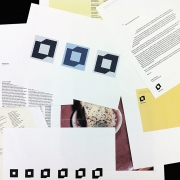
In celebration of Light Work’s 40th anniversary we’re pleased to launch a new identity in conjunction with this brand new website!

More on the website soon. First, lets talk identity… Over the past months we’ve been working closely with Michael Dyer and the team at the Brooklyn-based design firm Remake to develop this new look for the organization — from the logo, to the typefaces, and the pages of Contact Sheet, Mike and his team have carefully developed a more current aesthetic for the oraganization. We couldn’t be happier with the result.

To kick things off, we thought it’d be nice to chat with Mike about the process of developing Light Work’s new identity and show some behind-the-scenes moments of the studio and the design process. Enjoy!
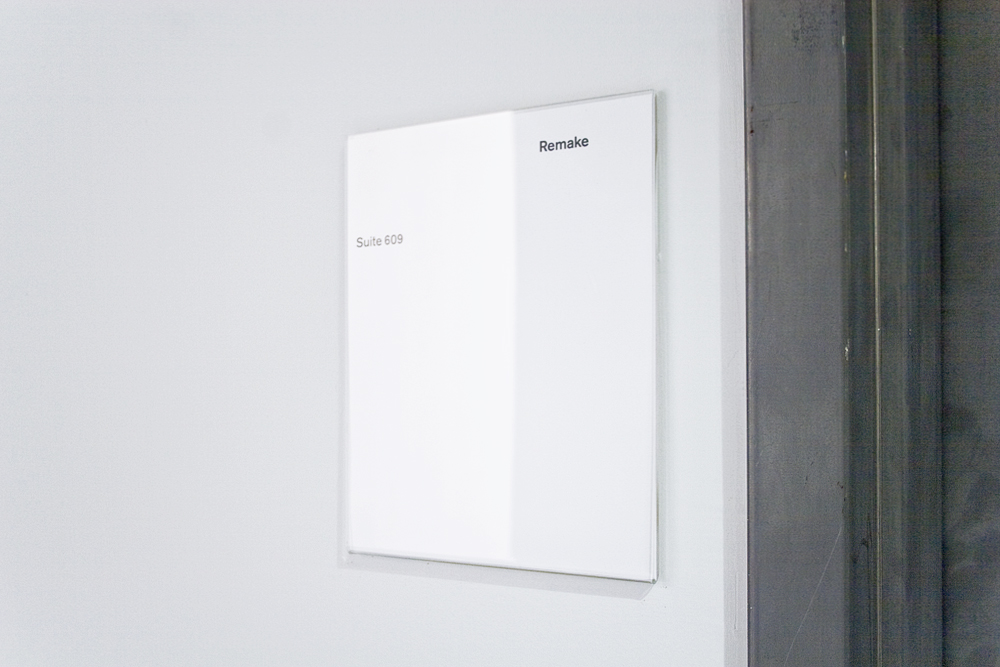
Remake, Brooklyn, NY
Remake studio, Brooklyn, NY

Shane Lavalette: Tell us about Remake and your approach to design.

Michael Dyer: I started Remake after many years of working for other studios in Washington DC and New York. Remake is intended to be a distillation of my approach to design, which is the reason I started the studio — to put principles directly into practice. Those principles grow out of a concern for the social responsibility of design, and a belief that anything one designs has to justify its existence by contributing to a qualitative improvement in the world. This may sound rather grand, but I really do see design as part of the production of culture.

Remake’s clients tend to often be from allied disciplines — architects, photographers, artists, galleries, museums, etc — although we work with plenty of corporations and businesspeople as well. Variety in clients and projects is important to me. That said, Remake specializes in two areas: corporate/brand identity, and printed publications (with a focus on books).
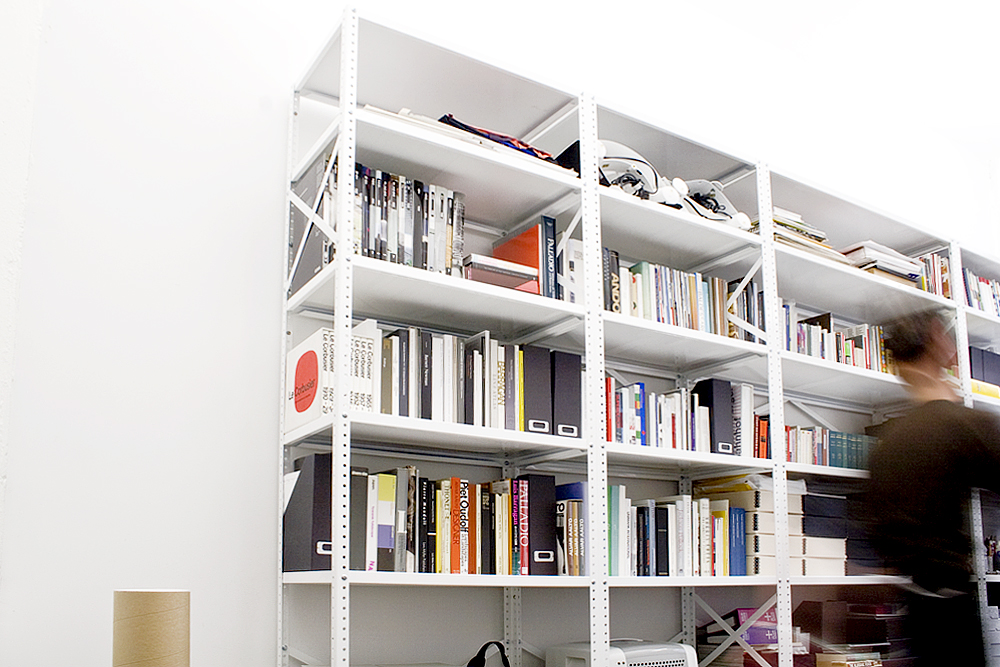
Remake, Brooklyn, NY
Remake studio, Brooklyn, NY

SL: Reinventing the identity of an organization is a challenging task, especially one as old as Light Work (this year marks our 40th year of supporting artists!). What was your approach in considering possible directions?

MD: In some ways the overall process that we employ for designing a visual identity is rather consistent, and has simply been developed/refined through experience. However, every project requires adjustments to this underlying process. Clients differ, communication objectives differ, audiences differ — all this has to be factored into the approach. But the basic methodology is a strong one and forms the backbone of our process which begins with in-depth discussions and identification of communication objectives, then progresses into exploration, development, refinement, and application of the design system.

When collaborating with Light Work, we had 40 years of history behind the conversations about where we were headed with the new identity. This provided a fantastic foundation on which to build. It also meant that we got a very concise explanation of what makes Light Work what it is, and its exceptionally unique and inspiring support of artists and their work. So we were very well equipped to judge the quality and efficacy of our work as it progressed from inception to application.
Remake, Brooklyn, NY
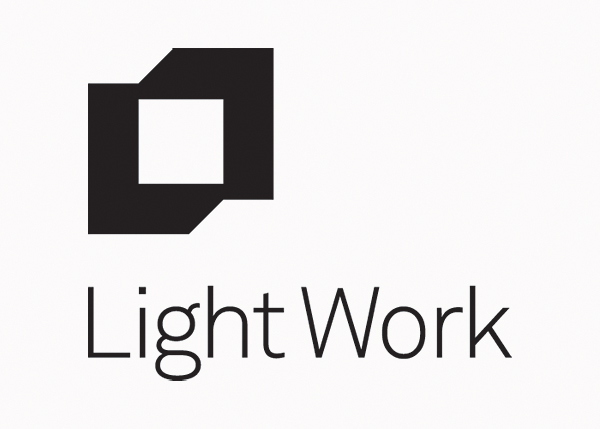
Light Work logo, 2013

SL: The new Light Work logo is minimal, geometric, modern, and is open to a variety of interpretations. How would you describe the ideas behind it?

MD: The new Light Work logo is comprised of two interlocking L shapes that suggest a shifting of perspective and a dialogue or synthesis between two- and three-dimensional form. (I say “suggest” because I think design is stronger when ideas are implied rather than when they are illustrated.) The square at its center represents light emanating from the surrounding form of a frame; it also suggests a view into or out of a space described by that same surrounding form. The square can also be read as representing the individual artist, supported by Light Work as the contextual structure around them.

The symbol being open to multiple viewpoints is, I think, critical to its success. People have to be able to invest a design with their own meaning to an extent. Designing things that are excessively didactic or literal is patronizing to the viewer and limits their ability to participate in the experience.

The new Light Work logo came after a long process of sketching, both by hand and on the computer. I’m a pretty loose sketcher, but there were a couple drawings that had a spark that would eventually lead to the solution, although it took a while for them to reveal themselves. In between, probably a couple hundred different designs were studied on the computer. Once the basic symbol had been designed it went through dozens of iterations. We considered the weight of the form, its compression, its color, how close or far apart the two L shapes were, etc. (And that’s even before we got into how it related to any typography.)
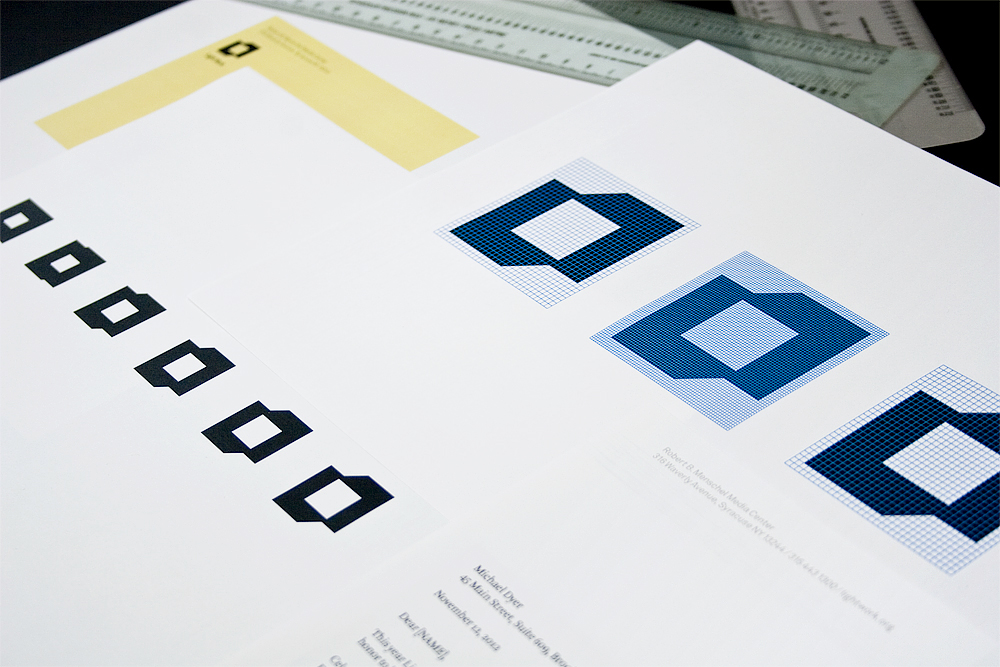
Remake, Brooklyn, NY
Light Work identity design process, Remake, Brooklyn, NY

SL: As designers, what is your approach to creating a lasting identity? What makes an organizations ‘look’ hold up for 10, 50, 100 years?

MD: 100 years is a tall order. But, yes, a constant concern in identity design, for me, is durability. I don’t endorse the cynical rapidity with which things sometimes change in the design world, especially in identity design where you are operating very near the heart of the institution or business. The process of designing an identity shouldn’t be one of prettifying or applying a cosmetic veneer — it should reach deep into the meaning and being of the organization and express something fundamental. It has to find a bit of the spirit of the organization, and that’s hard to do.

First, as a designer, I think you have to resist the urge to partake in superficial trends. Trends exist to expire. You are doing a client a tremendous disservice by using them as an excuse to participate in the Hot-New-Thing. Second, I think starting from a place of economy is best. Simple designs often endure, when they are carefully conceived and implemented. Third, I think the best work grows from a conceptual and formal synthesis — they are strong ideas expressed in powerful forms. Fourth, and most importantly, a designer has to listen to their client, carefully. This comes before all else. This is how you create something of substance that embodies fidelity to the spirit of the organization.

SL: The photographers and their work are always at the center of what Light Work does as an organization. How does design emphasize this?

MD: Yes, absolutely. Understanding the centrality of the photographers and their work was essential to developing the identity system, and the re-designed Contact Sheet and Light Work Annual as well. As I mentioned above, it’s even subtly referred to in the design of the new symbol itself.

We decided early on that the design system should be relatively quiet. It needed to be strong, it needed to be distinctive, but these did not preclude understatement. Details, always important, assumed an even greater weight. At all points we had to ensure that we were solving the communication problems, but in a manner that not only respected, but enhanced the presentation of the work. By addressing a range of design issues we were also creating a better overall setting within which the artists’ work could exist. In general, I feel the restraint and clarity of the new system is what allows the photographers’ work to really come through, take center stage, and shine.
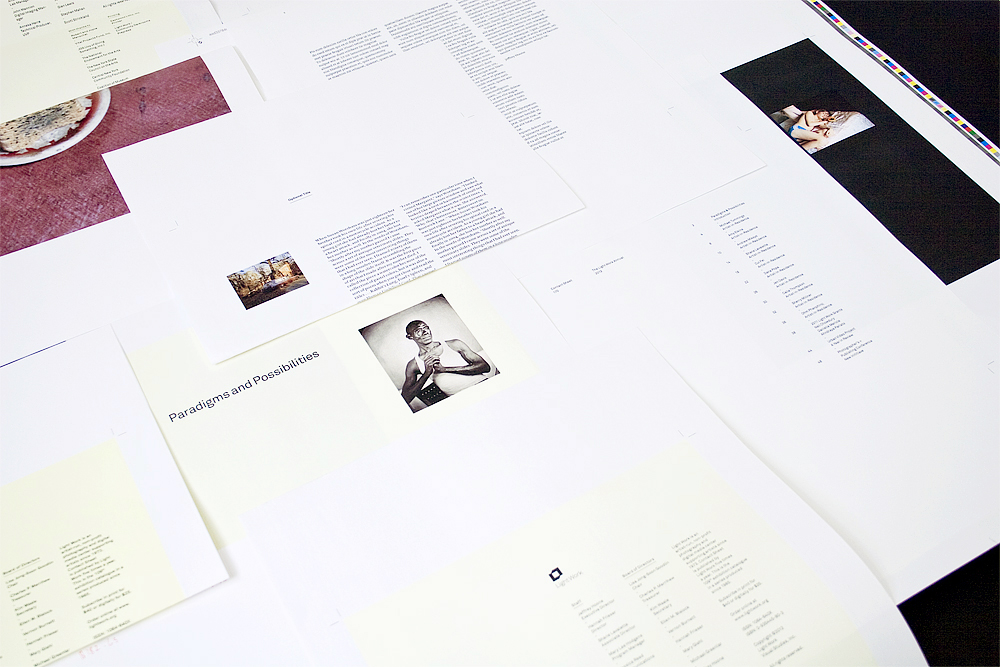
Remake, Brooklyn, NY
Light Work identity design process, Remake, Brooklyn, NY

SL: In ‘Remaking’ (excuse the pun) the Contact Sheet, what were some of the biggest changes? What should subscribers be excited about?

MD: Well, the biggest changes have to do with pacing and rhythm. We have worked hard to create something that has a meaningful ebb and flow as a reader/viewer moves through the piece. Engineering a sensitive typographic system has a lot to do with this, as does the structure of the underlying grid on which the design is built. But it’s also about using space more efficiently and dramatically, and color as well, to a more limited extent. We wanted to create a more nuanced atmosphere; this is something that can be very powerful when handled with discernment.

And I feel this is what everyone should be most excited about: the artists’ work will continue to be varied and of exceptional quality; we are just fine-tuning the overall experience of absorbing, contemplating, and responding to that work within the Contact Sheet‘s pages. It’s been extremely exciting for me as well.

—

Subscribe to Contact Sheet to be sure to get the first newly designed issue. Arriving in mailboxes Summer 2013!
https://www.lightwork.org/uploads/LightWork_Remake_01.jpg 747 1000 Shane Lavalette /uploads/LightWork.png Shane Lavalette2013-03-26 10:48:402019-02-20 21:13:58Light Work’s New Identity

A Month of Productivity

August 7, 2012/in News, Studio Visit

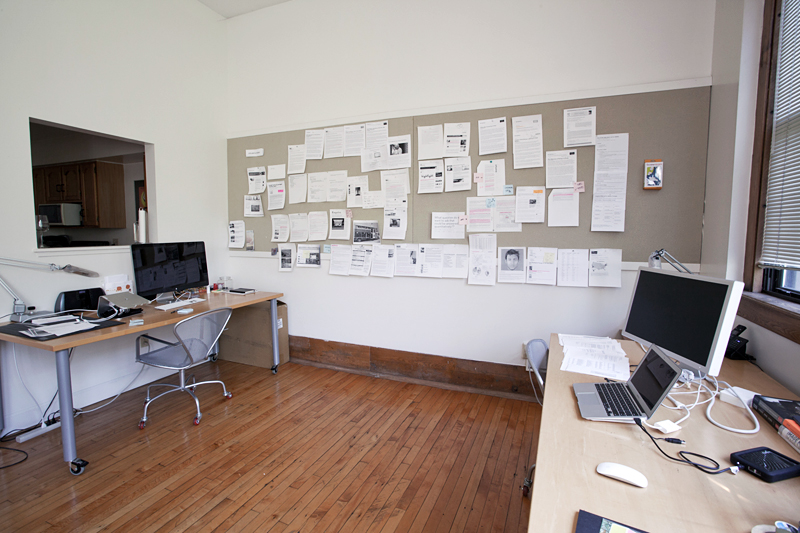
Collaborative artists Nate Larson and Marni Shindelman made great use of the artist apartment bulletin board and desks for fleshing out ideas during their July 2012 residency here at Light Work.

About their residency month, Nate had to say:

We loved our time at Light Work – for us, it was an incubator immerse ourselves in new ideas as a collaborative team. We spent our time building a studio in the artist apartment and then researching, reading, debating, discussing, proofing, editing, analyzing, and beginning new projects. We also developed new materials and goals towards our professional development. Our gratitude to the whole Light Work team for making it such a wonderful experience!

And Marni writes:

I spent the first two days at Light Work going through all my files and folders labeled “To Be Read.” While Nate and I were editing our Geolocation images, we also were working on new ideas. The time to think, brainstorm and read was invaluable to our work.

Find more information about Light Work’s Artist-in-Residence Program here.

https://www.lightwork.org/uploads/Larson_Shindelman_AIR_Apartment1.jpg 533 800 Shane Lavalette /uploads/LightWork.png Shane Lavalette2012-08-07 12:10:092013-03-26 10:58:55A Month of Productivity

Studio Visit: Brian Ulrich

April 28, 2011/in Studio Visit

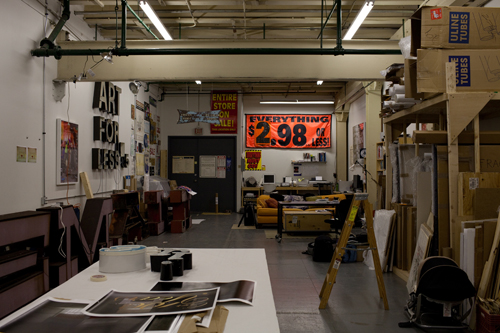
Since we’re in Chicago for the art fair, we’re bringing you all things Windy City for the week. Enjoy this virtual tour of Brian Ulrich’s studio. And then make sure to come visit us in Booth 12-266 at Art Chicago!

A few years ago I had a studio live/work space down in the Pilsen area of Chicago. It was a great place with good light and plenty of space. After some time I came to the conclusion that having my work several feet from my bed was not necessarily a productive thing. It was all too easy to continue working late into the evening, wake up, crawl back to the computer and pick up where I left off. Continuing on this path seemed a one-way street that was not going to lead to healthy living.

I found a smaller but nice space on the North side of Chicago in an area called Andersonville. This was a large converted factory building in a beautiful area near the Metra train. It was a bit strange walking by the small start-up businesses with their doors open in the morning (seemingly waiting for clients) but the change to have work to show up for and a home to return to in the evening was a welcome change.

Late last year, with many of my recent forays into collecting signage and retail artifacts, I was beginning to simply run out of space. After some looking I found a space nearly three times bigger than the Andersonville one for a small amount more per month. In order to store my framed works I had to rent a small storage unit; I was able to end that expense as well with the new bigger space.

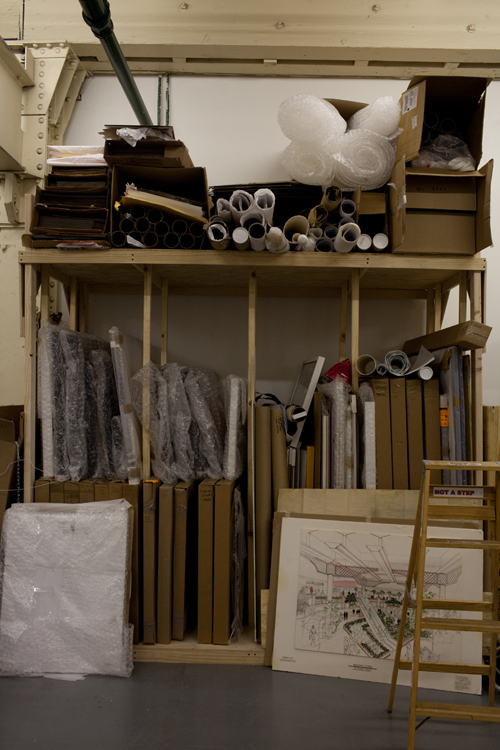
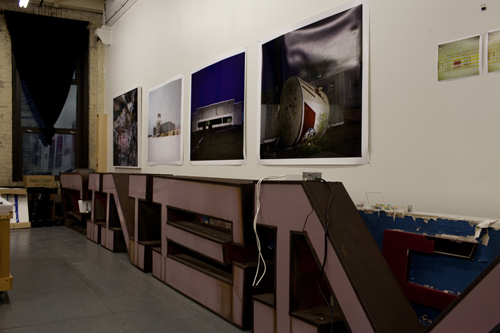
My studio assistant Jeffrey Brandsted and I did a fair job getting organized. Building a storage rack for the framed works, keeping the table movable to accommodate special projects. There is always the random last minute shipping container that needs to be built or a sign to disassemble, clean, and trace for new neon, mounts or whatnot.

Storage rack of framed works, shipping supplies, and Architect Rendering from Rolling Acres Mall.

This is the first space that allows me to have the opportunity to indulge a bit more. Specifically when I’m out photographing or collecting, I don’t have to be hampered by the fact that I simply won’t have space for an object. I can bring something back to the studio and then decide. Making lots of photographs leads one to remind oneself to trust the inclination to take a certain picture. The same goes for some of the objects. If there is a curiosity there, follow it.

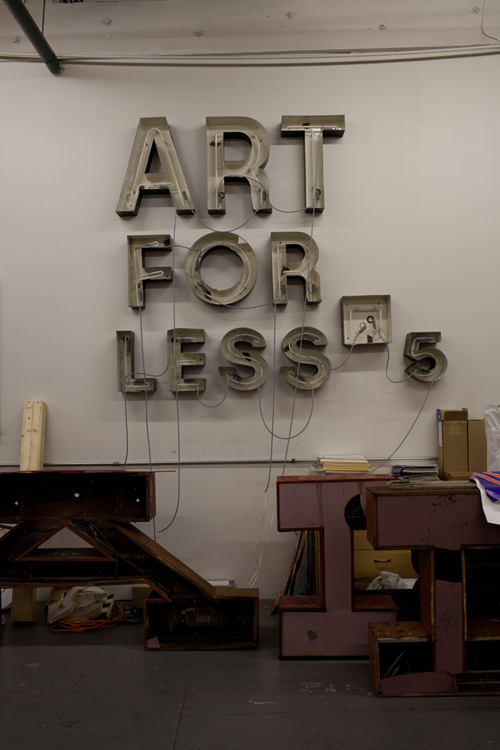
Art For Less #5 signage without plastic covers, being mocked up and testing power supplies. In foreground is recent rescue of Cinema sign.

View of Cinema I & II signage, Burt’s Shoes is behind it. A large framed 48 x 60″ print from Thrift is on the wall along with 3 Dark Store proofs (Richland Mall, 2009; Kids R Us, 2008; Kentucky Fried Chicken, 2009).

Currently I work with Jeff and my SAIC co-op intern Claire Demos. It’s quite amazing to have people around to help and share ideas. I do my best not to take that for granted, and Claire and I have many talks and have made occasional trips for her work which is really making strides. Over the years I’ve been incredibly lucky to have some great people work with me.

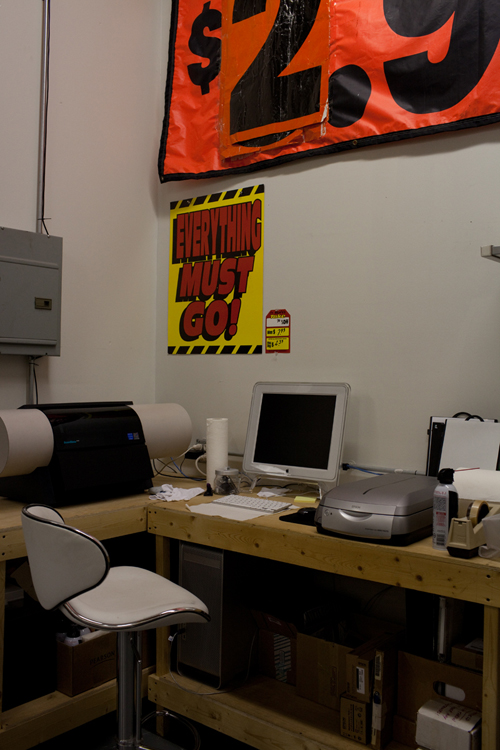
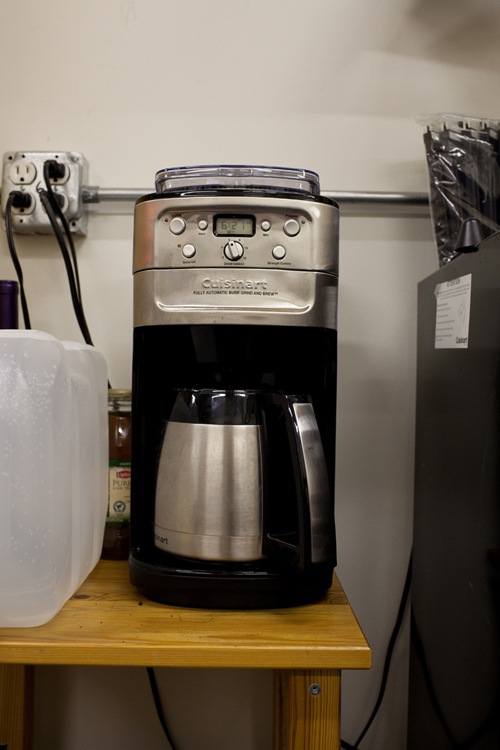
I also couldn’t do without my two Scanmate Drum Scanners, 1 Epson 9900, 1 Epson r2400, Shop vac, Coffee Maker, mini fridge (stocked with out dated film, hummus, and half and half), ladders, books, books, and books.

Scanning area. Scanmate 5000 scanner, older Mac for scanning, Epson flatbed for scanning objects and preliminary scans of film, swanky chair found outside a former strip club.

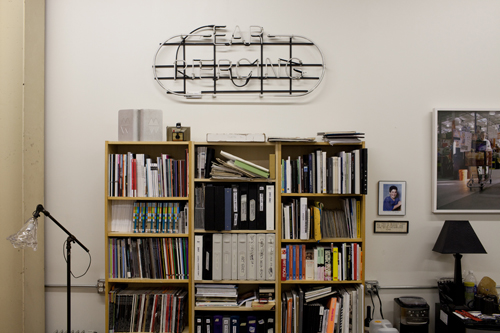
Bookshelf with archived negatives, Ear Piercing sign, retro Polaroid camera, Montgomery Ward door pulls, photograph of Jon Gitelson as a pre-teen with inscription “Have a Great Summer, See You At the Pool”, books and publications, custom lamp given as gift from Clevelandart. — Brian Ulrich

Brian Ulrich has spent the last decade researching and shooting the images in Copia, a series for which he won a John Simon Guggenheim Memorial Fellowship in 2009. Ulrich has exhibited his work at many venues, most recently at Robert Koch Gallery in San Francsico; Julie Saul Gallery, New York City; and the FotoFest Biennial in Houston, Texas. While not traveling the country making work, Ulrich teaches part time at the School of the Art Institute of Chicago. Read more about Brian Ulrich and his work at his website.

https://www.lightwork.org/uploads/Ulrich_MG_31481.jpg 333 500 Shane Lavalette /uploads/LightWork.png Shane Lavalette2011-04-28 15:14:132013-03-26 10:59:00Studio Visit: Brian Ulrich

Studio Visit: Judy Natal

March 23, 2011/in Studio Visit

Judy Natal will visit the Light Work booth during Art Chicago, held this year April 29-May 2, 2011, to talk about her work and sign copies of Contact Sheet 126. Stay tuned for more information on that event, and in the meantime, get to know Natal by reading this story about her experience running an Open Studio at Biosphere 2.

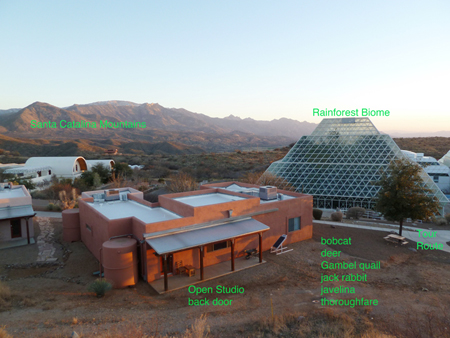
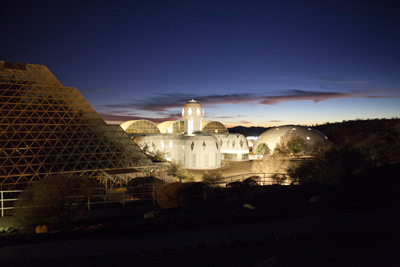
From November 1, 2010 to March 1, 2011, I created an Open Studio at the Biosphere 2 in Oracle, Arizona. I have been working at the Biosphere 2 on and off since I first set eyes on the place as a tourist taking a guided tour while attending a friend’s wedding in Tucson in June 2007. It was love at first sight! It is such a spectacularly peculiar place with a sordid past and a present and future of enormous promise where BIG science is now taking place, particularly around the issues of water. Which makes sense, when you consider that it is nestled in the beautiful Canyon del Oro, in the foothills of the Santa Catalina Mountains on the edge of the great Sonoran Desert.

The Biospherians created Biosphere 2 to explore space colonization. It was an enormous engineering feat, with five ecosystems under 66,000 panes of glass, and eight humans (with all the accompanying psycho-drama) sealed within the airtight facility for two years between 1991-1993. (See Biospherian Jayne Poynter’s account in her book The Human Experiment. It’s a page turner!). All the while, growing their own food, filtering their own waste and water, and orchestrating five ecosystems.

At the time of my visit, I had begun what has now become a four-year project, Future Perfect, that entails a photographic sweep of three peculiarly evocative sites where human intervention and land use are exploring the quality and state of futurity, illuminating the present moment and the choices we have yet to make.

Immediately upon my return from visiting Tucson and Biosphere 2, I proposed an artist residency there, and I have been working with Biosphere 2 ever since in a mutually beneficial relationship, helping to establish a residency program in 2008.

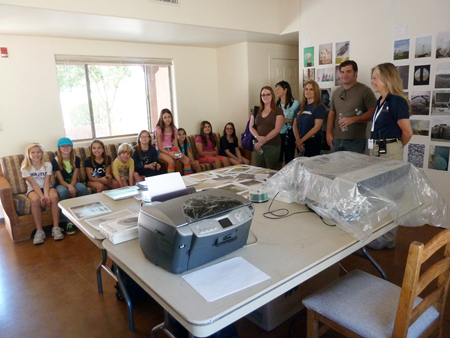
When I arrived at Biosphere 2 in November 2010, I knew my time was going to be different. Unlike my previous residencies at Biosphere 2, when I was in the field photographing every minute possible, I now had the intention of setting up an Open Studio, with an expectation of proofing, printing, editing, and sequencing the hundreds of photographs that I had made to date, with the goal of printing the work for exhibition and publication. With this realization, I proposed opening up my art practice to the hundreds of visitors who come to Biosphere 2 seven days a week. The B2 Institute Director Pierre Meystre, who I developed and enjoyed a supportive relationship with (this is key!), gave his enthusiastic support to my proposal, which placed a public face on the artist residency program. The interaction with the general public was enlightening and helped me hone my ability to speak about my new body of work. It also facilitated an ongoing dialogue about imagining the future, which was a primary goal for the project.

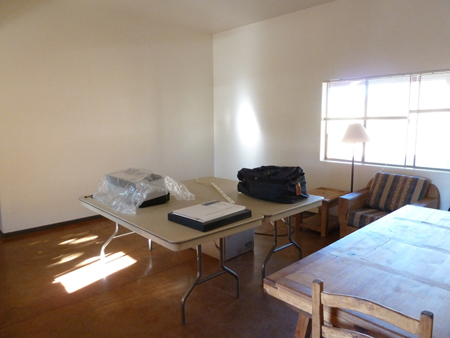
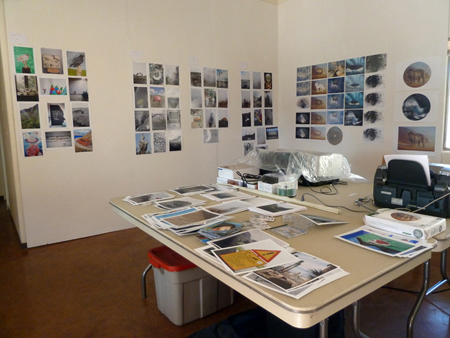
Immediately upon my arrival, I ordered wallboards that the maintenance staff helped me paint and install in the casita where I stayed. Within a day and a half of my arrival, the wallboards were up, prints were pinned to the wall, the two inkjet printers I brought with me were plugged in, the door was open (it’s winter in Arizona after all), and a sign welcoming Biosphere 2 visitors was up.

The ensuing four months were a gift, a unique opportunity, and a challenge. I began a series of photographic portraits of people who visited the Open Studio, which included staff, students, tour guides, and visitors from every walk of life. Nobel laureate scientists, poets, artists, photographers, writers, grad and under grad students, faculty, research assistants, engineers, k-12 classes, the American Boys Choir (accompanied by a brief concert), even one of my own students from Columbia College visited.

I also created a new body of work, now a limited edition portfolio of 35 prints, entitled Astral Projections, inspired by the writings of the renown biologist Edward O. Wilson, on the loss of biodiversity and animal extinction. This work was playful and full of color, and it relieved the tedium of proofing and printing.

The interruptions that happen at an Open Studio did take some getting used to, and I did feel like a bit of a broken record as I explained my work for each tour cycle. But I was surprisingly rewarded by the interactions, and I simply pulled my sign in when I needed a break. By 5pm, when the tours finished for the day, a beautiful calm, not to mention spectacular sunsets, descended on Biosphere 2, the only place of its kind, and what Life magazine called “one of the contemporary wonders” in the world. I am quite a solitary creature while I’m photographing and working, so this was a new experience for me. It was incredibly rich, endlessly surprising, and has me thinking about how I can do this in my studio in Chicago. I invite you to try it! —Judy Natal

Judy Natal was an Artist-in-Residence at Light Work in 2003, and her work was featured in an exhibition in the Light Work Main Gallery in 2004. Natal is a professor of photography at Columbia College in Chicago. Her work is the collection of institutions including the California Museum of Photography, Center for Creative Photography, and the Museum of Contemporary Photography, among many others. Her work has been exhibited at Projects International, The Nelson-Atkins Museum, and the Sao Paulo Biennial, among other venues.

https://www.lightwork.org/uploads/Natal_B2OpenStudio_11.jpg 338 450 Shane Lavalette /uploads/LightWork.png Shane Lavalette2011-03-23 12:05:092013-03-26 10:59:00Studio Visit: Judy Natal

Pages

  • Artist Index
  • Artist-in-Residence Program
  • Blog
  • Calendar
  • Camera Training Session
  • Canon 4000- Matte-Loaded (Ren Hang)
  • Canon Pro-1000 Matte & Luster (Claude Cahun)
  • Careers
  • Change Password
  • Checkout → Pay
  • Chronology
  • Critique Space
  • Darkroom
  • Digital Archive
  • Doireann O’Malley: New Maps of Hyperspace_Test_01 Online Exhibition
  • Drum Scanner Training
  • Edit My Address
  • Epson 11000XL (Langston Hughes)
  • Epson 11880-1 (Biggie Smalls)
  • Epson 4880-1 (Francesca Woodman)
  • Epson 4900-2 (Edward Weston)
  • Epson 4900-3 (Wegee)
  • Epson 4900-4 (Diane Arbus)
  • Epson 4900-5 (Robert Capa) Piezography K6
  • Epson 5000 Luster-Loaded (Bernice Abbott)
  • Epson 9800-1 Luster-Loaded (Gordon Parks)
  • Epson v700-1 (Mary Shelley)
  • Epson v700-2 (Sylvia Plath)
  • Exhibitions
  • Flatbed Scanner Training
  • Flextight Scanner Training
  • Flextight X1 (Kurt Vonnegut)
  • Free Orientation Session
  • Frequently Asked Questions (FAQ)
  • Frontpage
  • High Wattage: Intro to Lighting Studio
  • How to Apply
  • How to Apply
  • Howtek 4500 Drum Scanner (Roddy Piper)
  • Imacon (Susan Sontag)
  • Input: Import & Organize
  • Lab
  • Lab / Classes
  • Lab / Education
  • Lab / Membership
  • Lab / Reservations
  • Lab / Services
  • Lab / Upload Files
  • Large Format Printer Training
  • Light Work
  • Light Work + Autograph
  • Light Work Collection
  • Light Work Grants
  • Light Work Library
  • Light Work Reader
  • Light Work UVP Interact
  • Lighting Studio
  • Mission / History
  • Opportunities
  • Output: Process & Print
  • Partners & Sponsors
  • Print-Tool Tutorial
  • Return/Refund Policy
  • Sign Up for Our Newsletter
  • Small Format Printer Training
  • Staff
  • Thanks
  • The Dark Arts: Intro to Darkroom
  • Track your order
  • Upcoming Exhibitions
  • Urban Video Project (UVP) / Events
  • Urban Video Project (UVP) Commission
  • Urban Video Project (UVP) Exhibitions
  • UVP Community Nights
  • View Order
  • Visit / Contact

Categories

  • Close Readings
  • Elsewhere
  • Etc.
  • Events
  • Exhibitions
  • From the Files
  • Interviews
  • Lab
  • News
  • Re:Collection
  • Shop
  • Studio Visit
  • Urban Video Project
  • Watch

Archive

  • April 2026
  • October 2025
  • May 2025
  • September 2024
  • May 2024
  • November 2023
  • October 2023
  • September 2023
  • June 2023
  • May 2023
  • February 2023
  • September 2022
  • August 2022
  • May 2022
  • April 2022
  • March 2022
  • January 2022
  • November 2021
  • October 2021
  • September 2021
  • August 2021
  • July 2021
  • June 2021
  • May 2021
  • April 2021
  • March 2021
  • February 2021
  • January 2021
  • October 2020
  • August 2020
  • July 2020
  • June 2020
  • May 2020
  • April 2020
  • March 2020
  • February 2020
  • September 2019
  • July 2019
  • May 2019
  • April 2019
  • March 2019
  • February 2019
  • January 2019
  • December 2018
  • September 2018
  • August 2018
  • May 2018
  • April 2018
  • February 2018
  • October 2017
  • July 2017
  • February 2017
  • December 2016
  • November 2016
  • September 2016
  • July 2016
  • May 2016
  • March 2016
  • February 2016
  • December 2015
  • November 2015
  • October 2015
  • September 2015
  • August 2015
  • June 2015
  • May 2015
  • April 2015
  • March 2015
  • January 2015
  • December 2014
  • November 2014
  • October 2014
  • July 2014
  • June 2014
  • May 2014
  • April 2014
  • March 2014
  • February 2014
  • January 2014
  • December 2013
  • November 2013
  • October 2013
  • September 2013
  • June 2013
  • May 2013
  • April 2013
  • March 2013
  • February 2013
  • January 2013
  • December 2012
  • November 2012
  • October 2012
  • September 2012
  • August 2012
  • June 2012
  • May 2012
  • April 2012
  • March 2012
  • February 2012
  • January 2012
  • December 2011
  • November 2011
  • September 2011
  • August 2011
  • June 2011
  • May 2011
  • April 2011
  • March 2011
  • February 2011
  • January 2011
  • December 2010
  • November 2010
  • October 2010
  • September 2010
  • August 2010
  • July 2010
  • June 2010
  • May 2010
  • April 2010
  • March 2010
  • February 2010
  • January 2010
  • December 2009
  • November 2009
  • October 2009
  • September 2009
  • August 2009
  • July 2009
  • June 2009
  • May 2009
  • April 2009
  • March 2009
  • February 2009

Light Work was founded as an artist-run non-profit organization in 1973.

Our mission is to provide direct support to artists working in photography and related media, through residencies, publications, and a community-access lab facility.

Read more →

Light Work Lab offers members a the highest quality printing and scanning equipment, black-and-white darkroom, a lighting studio, and a lounge and library where artists from all over the world converge.

Become a member today →

Connect with Light Work

Instagram →
Facebook →
Twitter →
Vimeo →
Newsletter →

Copyright ©1973– Light Work — 316 Waverly Ave. Syracuse, NY 13244
  • Link to Mail
  • Link to X
  • Link to Facebook
  • Link to Instagram
  • Link to Vimeo
  • Link to Vimeo
  • Link to Rss this site
Scroll to top Scroll to top Scroll to top