Rachelle Mozman’s exhibition Costa del Estes is currently on view at Aguilar Library in New York City until April 2, 2011. Rachelle and I recently talked about Costa and her other work in an email interview that traverses the suburbs of New Jersey and Panama, the politics of being a child in different cultures, and Mozman’s latest images of her mother.
Mary Goodwin: Earlier this month, you opened a show of your work Costa del Estes at the Aguilar Library as part of En Foco’s Touring Gallery Exhibition series. Costa del Estes, as well as a parallel series called American Exurbia, have been developed over the past couple of years. These bodies of work imagine the life of children in gated communities in Central America and the United States, settings that you describe as “. . . isolated, secure, and homogenous.” How did you get interested in making work about these communities?
Rachelle Mozman: I was initially interested in photographing what I saw to be the changing landscape of areas now known as exurbia in New Jersey. I had been driving out to teach at a community college in Randolph New Jersey, and I simply started noticing all the new corporate campuses and gated communities going up where woods once were. I was very attracted to photographing the changes. I started out making photographs of security guards in front of their posts, but then was drawn to the women I would see and then introduce myself to in the Dunkin Donuts. Then, gradually, through photographing the women in their homes, I became very interested in photographing their children. Once I began making photographs of the children, there was something that was coming through in the pictures that was very emotional for me, and I found myself narrowing in and just focusing on the children. I had grown up partially in the suburbs of New Jersey as a teenager, and I always felt a profound isolation in the American suburbs. When I realized that exurbia and the gated community was taking the idea of the suburb to a new level of isolation and homogeneity of class, I was really drawn to exploring this, and the fantasy of isolation in order to achieve safety from the city and the other.
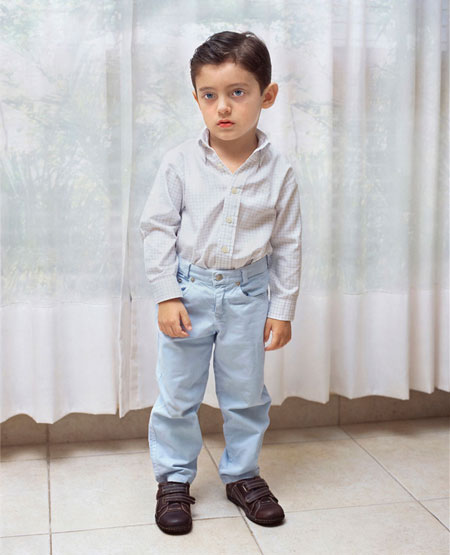
When I traveled to Panama in 2005 and realized that the gated community phenomenon had moved down there, I felt I had to make photographs. Costa del Este is the name of this gated community, where in essence all the middle class and wealthy Panamanians have moved to in the last five years. Each neighborhood has a gate, and they have a separate school, mall, etc. I was fascinated by the imitation of American lifestyle, but in a very Latin American, Panamanian way. Children there are brought up in a very small bubble, again from fear of interacting with another class or race, and fear of crime. But incidentally as the wealth and separation of class grows, so does the crime.
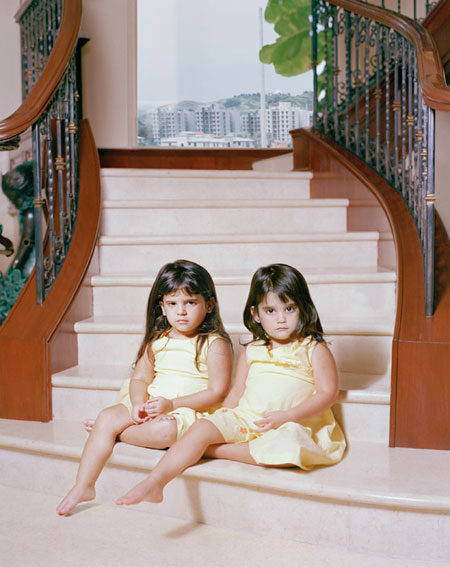
MG: There’s a curious power dynamic going on in Costa. All of the subjects are quite young, with the oldest looking not even tween. However, the helplessness and dependency associated with being that young is equalized in a couple of ways. Firstly, the camera is always at the children’s level giving their gaze as much importance as the viewers’. Secondly, the children don’t act like children — the way they stand and gesture has an oddly adult character to it. Do the children somehow reference the adults who also presumably populate these interiors?
RM: Yes, absolutely, the children in Costa do reference the adults. It could also be due to how they are taught to interact in front of a camera, as well as my interest in representing who they might be when they are adults. I believe the power dynamic that is picked up on in the photographs is based on the children’s sense of self-identity as an adult might have. It’s an identity that is tied to a sense of entitlement. Because the children rarely interact with people they don’t know (they are primarily in a small circle of their family and their maids), I often felt while photographing that they saw me as hired help. This is partly why there is that sense of power in their pose, and also why I chose to place the camera at eye level. I was drawn to revealing this and their conditioning. But after a few years I became very saddened by it.
MG: How have the children reacted to seeing themselves in your images?
RM: They often feel that the photographs are beautiful, but because they are not being represented in a way they are accustomed to seeing in the local socialite magazines, hair being fluffed, and heads tilted to one side, the pictures don’t appeal to them enough. They also do not see these photographs as art, more as snapshots of people they know. As a consequence they would never buy one and place it in their homes, because it would be a snapshot of some one else’s child.
MG: Who have you been looking at as you’ve developed this series? Which artists have influenced your work along the way?
RM: Roger Ballen is an influence. Also the work of August Sander is an influence, as well as the painter Velasquez and other portrait painters of the 16th and 17th century. I was thinking a lot about the strangeness of some of Sander’s portraits as well as the representation of identity and power in the paintings of Velasquez. I am often told my pictures are strange, but it’s not something I intentionally aim for. I feel that Sander was not trying to make strange images either, but sometimes something is revealed there. This tension is something that I am interested in.
MG: Tell us a little about your participation with En Foco. How have they supported you as an artist, and specifically this exhibition? What is their Touring Gallery Exhibition series — will Costa tour to multiple venues?
RM: En Foco has been wonderful, and I am very happy that they invited me to exhibit. They are a very important institution, and they do wonderful work. I love the idea of placing this work outside the context of the art world into the community. There are no immediate plans as of yet to continue touring the exhibit, but I would be happy to do it!
MG: While you were a Light Work Artist-in-Residence, you worked on printing images from Costa and Exurbia and also on shooting images for the series that eventually became Scout Promise. Can you explain what the Girl Scout Promise is for those who weren’t Scouts themselves earlier in life? Promise seems to be connected to your earlier series through the idea of exclusive communities/groups that impose an artificial order on childhood. Although in Promise, the children seem to have a healthier, more connected relationship with the environment?
RM: Yes, I am really interested in exploring that “artificial order” on childhood you mention. But I think it’s my interest in how societies are structured and how children are conditioned that is at the heart of my interest in photographing childhood. In Girl Scout culture the promise is at the center of what they teach the girls. I found it to be simultaneously beautiful and terrifying that the girls would recite this promise at the start of every meeting.
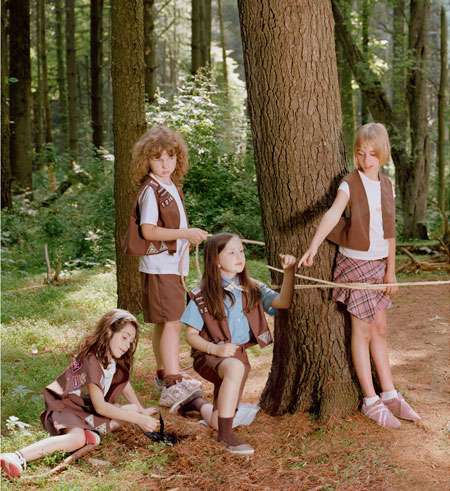
It’s the same attraction and terror I feel toward any structured group. In general I find the Girl Scouts to be very positive and even essential for girls, particularly in third world countries. I photographed the girl scouts in Panama, and I found it to be so important. In countries where the feminist movement has not gained strength, or where women have fewer rights, I feel that the Girl Scouts offer a great support and outlook for the girls. Who else in a predominantly Catholic country will teach them about sex education and the importance of protection against sexually transmitted disease?
MG: Most recently, you’ve started making pictures of your mother. Please tell us about this most recent series.
RM: The photographs of my mother are more overtly performative and theatrical than my previous work, although one can tell in my prior portraits that I am interested in blending the document with the narrative. The work with my mother, entitled Casa de Mujeres, represents three characters that are all played by my mother: an upper class woman, her darker twin sister, and her maid.
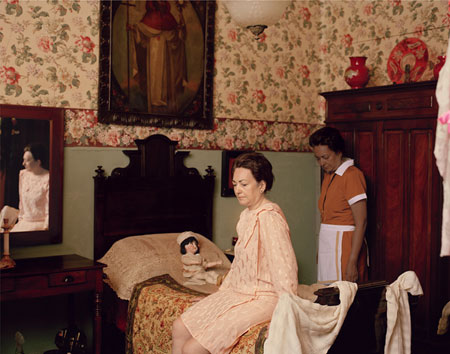
To make these images I borrowed heavily from stories from within my own Panamanian family. But the images represent a fictional home in a fictional Latin American country. In fact, so far I have photographed within the colonial homes of three Central American countries to make these images. The pictures address the conflict of race and class that can exist under one roof within Latin America, as well as within one person. Ultimately these photographs can be read as portraits of my mother as her various selves—like a nested doll—and read as images that reveal the conflict of vanity, race, and class that live within one woman.
MG: Costa del Este will be at the Library until April 2. What’s next in terms of exhibitions and publications? Where can we look for your work in 2011?
RM: In March I will be exhibiting in the launch of Humble Arts Foundation book launch of Collectors Guide Vol. 2. In June I will be exhibiting in the S Files Biennial at El Museo del Barrio, and later in the year I will be exhibiting in a commissioned project for Foto España.
MG: Thanks for catching us up on your work, Rachelle.
Images (from top): Cost Azul, 2006; Twins in Yellow, 2007; Group of four with rope, 2009; En el cuarto de la niña, 2010.

Thilde Jensen speaks about art and illness
/in NewsThilde Jensen talks about her series Canaries in this great interview with Syracuse University Goldring student Lily Betjeman. An exhibition of Canaries, which depicts people living with Multiple Chemical Sensitivity, is currently on view at Light Work until May 27.
Canaries from Light Work on Vimeo.
Studio Visit: Judy Natal
/in Studio VisitJudy Natal will visit the Light Work booth during Art Chicago, held this year April 29-May 2, 2011, to talk about her work and sign copies of Contact Sheet 126. Stay tuned for more information on that event, and in the meantime, get to know Natal by reading this story about her experience running an Open Studio at Biosphere 2.
From November 1, 2010 to March 1, 2011, I created an Open Studio at the Biosphere 2 in Oracle, Arizona. I have been working at the Biosphere 2 on and off since I first set eyes on the place as a tourist taking a guided tour while attending a friend’s wedding in Tucson in June 2007. It was love at first sight! It is such a spectacularly peculiar place with a sordid past and a present and future of enormous promise where BIG science is now taking place, particularly around the issues of water. Which makes sense, when you consider that it is nestled in the beautiful Canyon del Oro, in the foothills of the Santa Catalina Mountains on the edge of the great Sonoran Desert.
The Biospherians created Biosphere 2 to explore space colonization. It was an enormous engineering feat, with five ecosystems under 66,000 panes of glass, and eight humans (with all the accompanying psycho-drama) sealed within the airtight facility for two years between 1991-1993. (See Biospherian Jayne Poynter’s account in her book The Human Experiment. It’s a page turner!). All the while, growing their own food, filtering their own waste and water, and orchestrating five ecosystems.
At the time of my visit, I had begun what has now become a four-year project, Future Perfect, that entails a photographic sweep of three peculiarly evocative sites where human intervention and land use are exploring the quality and state of futurity, illuminating the present moment and the choices we have yet to make.
Immediately upon my return from visiting Tucson and Biosphere 2, I proposed an artist residency there, and I have been working with Biosphere 2 ever since in a mutually beneficial relationship, helping to establish a residency program in 2008.
When I arrived at Biosphere 2 in November 2010, I knew my time was going to be different. Unlike my previous residencies at Biosphere 2, when I was in the field photographing every minute possible, I now had the intention of setting up an Open Studio, with an expectation of proofing, printing, editing, and sequencing the hundreds of photographs that I had made to date, with the goal of printing the work for exhibition and publication. With this realization, I proposed opening up my art practice to the hundreds of visitors who come to Biosphere 2 seven days a week. The B2 Institute Director Pierre Meystre, who I developed and enjoyed a supportive relationship with (this is key!), gave his enthusiastic support to my proposal, which placed a public face on the artist residency program. The interaction with the general public was enlightening and helped me hone my ability to speak about my new body of work. It also facilitated an ongoing dialogue about imagining the future, which was a primary goal for the project.
Immediately upon my arrival, I ordered wallboards that the maintenance staff helped me paint and install in the casita where I stayed. Within a day and a half of my arrival, the wallboards were up, prints were pinned to the wall, the two inkjet printers I brought with me were plugged in, the door was open (it’s winter in Arizona after all), and a sign welcoming Biosphere 2 visitors was up.
The ensuing four months were a gift, a unique opportunity, and a challenge. I began a series of photographic portraits of people who visited the Open Studio, which included staff, students, tour guides, and visitors from every walk of life. Nobel laureate scientists, poets, artists, photographers, writers, grad and under grad students, faculty, research assistants, engineers, k-12 classes, the American Boys Choir (accompanied by a brief concert), even one of my own students from Columbia College visited.
I also created a new body of work, now a limited edition portfolio of 35 prints, entitled Astral Projections, inspired by the writings of the renown biologist Edward O. Wilson, on the loss of biodiversity and animal extinction. This work was playful and full of color, and it relieved the tedium of proofing and printing.
The interruptions that happen at an Open Studio did take some getting used to, and I did feel like a bit of a broken record as I explained my work for each tour cycle. But I was surprisingly rewarded by the interactions, and I simply pulled my sign in when I needed a break. By 5pm, when the tours finished for the day, a beautiful calm, not to mention spectacular sunsets, descended on Biosphere 2, the only place of its kind, and what Life magazine called “one of the contemporary wonders” in the world. I am quite a solitary creature while I’m photographing and working, so this was a new experience for me. It was incredibly rich, endlessly surprising, and has me thinking about how I can do this in my studio in Chicago. I invite you to try it! —Judy Natal
Judy Natal was an Artist-in-Residence at Light Work in 2003, and her work was featured in an exhibition in the Light Work Main Gallery in 2004. Natal is a professor of photography at Columbia College in Chicago. Her work is the collection of institutions including the California Museum of Photography, Center for Creative Photography, and the Museum of Contemporary Photography, among many others. Her work has been exhibited at Projects International, The Nelson-Atkins Museum, and the Sao Paulo Biennial, among other venues.
Jeffrey Henson Scales: That Year of Living
/in ExhibitionsLight Work is pleased to announce the exhibition That Year of Living featuring stunning black-and-white photographs by Jeffrey Henson Scales. Diagnosed with cancer in 2008, Scales was forced to, in his words, weigh the possibilities of his own demise, and whether he had achieved what he felt he was put here to do. It was this diagnosis and contemplation, along with the urging of his wife, Meg Henson Scales, which led him to return to making photographs on a daily basis.
The images in That Year of Living were made in the year following his cancer diagnosis and surgery. Scales photographed mainly in and around Times Square, depicting the part of New York City that he visited every day going to and from work at The New York Times. The images capture the certain hardness mixed with joy, sadness, determination, and bewilderment that is found in the faces of young and old alike in New York City. Created in the months following his own experience with mortality, the photographs explore the journey of life and death found in the faces on the streets of New York.
According to Scales, “I believe the world outside is never a static experience. Life on the street in New York City is always changing and I have and always will love to see what it looks like, photographed. I never bore of the state of contemporary life as it is reflected in the faces of people, the states of nature, the stuff of life itself. As such, I hope to always be making photographs of this thing: life—even when it transmogrifies into its natural endpoint.”
About the Artist
Scales has spent more than forty years as a documentary photographer. His work has been exhibited internationally, and has appeared in numerous photography books, magazines, and anthologies. His work is included in the permanent collections of The Museum of Modern Art, the George Eastman House, and the Baltimore Museum of Art. Scales has been a photography editor for The New York Times since 1998, editing The Week in Review, The Book Review, and co- editing The Year in Pictures. He is also an adjunct professor at the Tisch School of the Arts of New York University. He and his wife own the Harlem-based photo archive, HSP Archive, and the multimedia production company, Henson Scales Productions. His work can be viewed atwww.jeffreyscales.com.
Also on view at this time is Canaries, an exhibition of photographs by Thilde Jensen. The images in this exhibition are a personal account of the life Jensen has lived with Multiple Chemical Sensitivity, and the people she has met who suffer the same condition. People with this sensitivity have been dubbed “human canaries,” and they are the casualties of what Jensen calls a “ubiquitous synthetic chemical culture.” Jensen became so sensitive to chemicals in the air that she could not sit in traffic, read a book, or sit next to someone wearing perfume. She was forced to wear a gas mask when entering banks, supermarkets, and doctor’s offices. She left her life in New York City, her husband and her career, and moved to the country where she lived in a tent away from the regular chemicals such as laundry detergents, pesticides, and exhaust fumes.
Gallery hours for these exhibitions are Sunday to Friday, 10am-6pm, and by appointment. To schedule an appointment, please call 315-443-1300. Both the exhibition and reception are free and open to the public. Paid parking is available in Booth Parking Garage.
Light Work invites groups and individuals to schedule tours and gallery talks of the exhibition and facility. Light Work is a non-profit, artist-run organization dedicated to the support of artists working in photography and electronic media. Light Work is a member of CMAC, the Coalition of Museum and Art Centers at Syracuse University.
For more information, please contact Jessica H. Reed at Light Work, 315-443-1300 or jhreed01@syr.edu.
Thilde Jensen: Canaries
/in ExhibitionsLight Work is pleased to announce the exhibition Canary, an exhibition of photographs by Thilde Jensen. The images in this exhibition are a personal account of the life Jensen has lived with Multiple Chemical Sensitivity (MCS), and the people she has met who suffer the same condition.
Jensen, born in Denmark, moved to New York City in 1997 to study photography after an early exploration into film making. Six years later her life and career as a documentary and editorial photographer were cut short by a sudden development of severe MCS. The urban life she had previously navigated with ease transformed into a toxic war zone. Her immune system crashed, forcing her into a survivalist journey, unraveling the comfort and construct of her previous life. The ensuing years were a lesson in basic survival—camping in the woods and wearing a respirator when entering supermarkets, doctors’ offices, and banks.
To her surprise an otherwise invisible subculture of people emerged who shared this isolated existence. Photographing became a medium for sanity and meaning in this hyper-sensitive dimension of reality. Her photographs are a personal account of life on the edge of modern civilization as one of the human canaries, the first casualties to a ubiquitous synthetic chemical culture.
Since World War II the production and use of synthetic chemicals has exploded. During the course of an average day, people come into contact with a host of chemicals. Just walking into a supermarket one might be breathing as many as 20,000 different synthetic compounds. As a result of the prevalence of these synthetic chemicals, it is believed that more than 10 million Americans have developed MCS. Many people with MCS are forced to live in remote areas in tents, cars, or retro-fitted trailers, away from dangers of neighbors’ chemical use. Others are prisoners of their homes, with advanced air filter systems to keep outside air from contaminating their breathing space.
Gallery hours for this exhibition is Sunday to Friday, 10am–6pm, and by appointment. To schedule an appointment, please call 315-443-1300. Both the exhibition and reception are free and open to the public. Paid parking is available in Booth Parking Garage.
Light Work invites groups and individuals to schedule tours and gallery talks of the exhibition and facility. Light Work is a non-profit, artist-run organization dedicated to the support of artists working in photography and electronic media. Light Work is a member of CMAC, the Coalition of Museum and Art Centers at Syracuse University.
For more information, please contact Jessica Reed at Light Work, 315-443-1300 or jhreed01@syr.edu.
Best from the Rest: Lola Flash interview with Nono Osuji
/in ElsewhereCheck out this fantastic video interview of Lola Flash by Nono Osuji. Lola talks about many things, including being honest in your work as an artist, her first camera (a Minox), addressing racism and homophobia in her images, and the latest phase of her ongoing project Epicene.
Lola Flash was a Light Work Artist-in-Residence in 2008. Her work is featured in the Light Work Annual 152 and in the Light Work Collection.
2011 Light Work Artists-in-Residence
/in NewsCongratulations to the 2011 Light Work Artists-in-Residence, who were selected from an amazing pool of hundreds of applicants. Thanks to all who submitted materials and showed patience throughout the process.
We’re very pleased to host the following Artists-in-Residence in 2011:
Jen Davis
Amy Elkins
Sam Falls
Cui Fei
Shane Lavalette
Andrew Miksys
Sherry Millner
Dana Popa
Ohm Phanphiroj
Michael Tummings
Calla Thompson
Our renowned residency program features a $4,000 stipend, a free place to stay for the month, 24-hour access to our state-of-the-art facility, and generous staff support. Light Work was founded in 1973 as a non-profit, artist-run organization. We provide direct support to artists working in the media of photography and digital imaging through residencies, publications, exhibitions, a community-access digital lab facility, and other related projects.
Image: Michael Tummings, from the series Hidden
Light Work at SCOPE New York, Booth #C58
/in NewsWe’re so excited to have a booth at the SCOPE New York International Art Fair, which begins next week on March 3. Mary Lee Hodgens, our Program Manager, and myself will both be in booth #C58 talking to artists and art lovers about our residency program, exhibitions, and our journal Contact Sheet. Of course, we will also be selling lovely limited edition, signed and numbered prints from our Fine Print Program, as well as an assortment of beautiful signed books. If you’re in the New York area, please stop by, visit with us, hear all about the latest in our mission to support the best in emerging photography, and support us with the purchase of a print or book. Every penny we make through these sales goes right back into our programs.
Carrie Mae Weems – Kitchen Table Series
Untitled, from the Kitchen Table Series, 1990/2010
Silver gelatin print, 9 7/8 x 9 3/4″ image on a 14 x 11″ sheet
Signed and numbered print in a limited edition of 100
Available online here and at SCOPE New York, Booth #C58
Click here to read more about attending SCOPE New York including ticket prices and admission times. See you at Booth #C58!
—Mary Goodwin, Associate Director
Best from the Rest: Forward Thinking Museum & PAL
/in NewsThe Forward Thinking Museum has posted a wonderful video about an exciting project taking place with local students in Syracuse, New York. The Photography and Literacy Project (PAL) builds visual and verbal literacy, as well as self-confidence, by asking students to explore their lives through photography and writing. PAL founder and director Stephen Mahan launched the project in July 2010, and ever since then, hundreds of students have filled just as many notebooks with their thoughts and observations. Mahan explains, “Our educational system is set up to deal most effectively with one type of learner, and I was the ‘other’ type of student with reading and attention problems that made me feel a certain way. So what I try to do is even the playing field by using a camera as a storytelling device that articulates and validates each individual’s point of view, which builds self esteem. When the pictures are all laid out on the table, it is impossible to tell which kid has difficulties, and that is what motivates my passion.” Click on the image below to see the video and read more about PAL.
Best from the Rest: Left of Black
/in ElsewhereCheck out this amazing conversation between Carrie Mae Weems and Duke University Professor Mark Anthony Neal from Left of Black. They talk about many of Weems’ iconic series, including the Kitchen Table Series, From Here I Saw What Happened and I Cried, Slow Fade to Black, Constructing History, and her latest project, in collaboration with Social Studies 101, called Operation Activate, a grass roots public art anti-violence intervention in Syracuse, New York. We’d love to hear your thoughts about the interview, and it would be great to hear from people living in Syracuse about how Operation Activate has impacted the community. Please leave your comments down below!
From the Files: Ode to the Slide Sheet
/in From the FilesMost work that comes into Light Work these days—in applications for our Artist-in-Residence program, exhibition opportunities, or publishing projects—is in the form of digital files on a disk. The screen, of course, possesses a luminescence of its own and is undoubtedly a great way to show and look at work easily, quickly, and inexpensively.
The sheet is mostly comprised of work from her Menschenkunde series, which she describes in her application:
“With my Renaissance-style photographs I try to open the viewer’s mind to experience art as a combination of facts, beauty, and irony. The true subject of my portraits may be termed the question of representation. By capturing the lighting, composition, and mood of portraits by Old Masters, I achieve a double irony: first, my photographs portray contemporary persons; and second, they evoke familiar paintings. These images reflect on the very essence of portraiture; what is a unique person, and what a unique likeness? According to Jakob Burckhardt, a 19th-century Swiss art historian, portraits by Renaissance artists like Dürer, Rembrandt, and Vermeer linked beauty and psychological insight. I draw concepts from art history to express my intentions.”
We liked what we saw in the application, and Angelika has been a friend ever since. She completed her residency in 2005. Work from her series Menschenkunde, Felsenfest, and Seelensucht was featured in Contact Sheet 144 and a Light Work Main Gallery exhibition in 2007. Her image Felsenfest 1—Agatha, below, is in the Light Work Collection and the print Menschenkunde VII is in the Light Work Fine Print Program.
And it all started with an amazing slide sheet, well edited and jumping off the light table.
—Mary Goodwin, Associate Director
Rachelle Mozman on Costa del Estes
/in NewsRachelle Mozman’s exhibition Costa del Estes is currently on view at Aguilar Library in New York City until April 2, 2011. Rachelle and I recently talked about Costa and her other work in an email interview that traverses the suburbs of New Jersey and Panama, the politics of being a child in different cultures, and Mozman’s latest images of her mother.
Mary Goodwin: Earlier this month, you opened a show of your work Costa del Estes at the Aguilar Library as part of En Foco’s Touring Gallery Exhibition series. Costa del Estes, as well as a parallel series called American Exurbia, have been developed over the past couple of years. These bodies of work imagine the life of children in gated communities in Central America and the United States, settings that you describe as “. . . isolated, secure, and homogenous.” How did you get interested in making work about these communities?
Rachelle Mozman: I was initially interested in photographing what I saw to be the changing landscape of areas now known as exurbia in New Jersey. I had been driving out to teach at a community college in Randolph New Jersey, and I simply started noticing all the new corporate campuses and gated communities going up where woods once were. I was very attracted to photographing the changes. I started out making photographs of security guards in front of their posts, but then was drawn to the women I would see and then introduce myself to in the Dunkin Donuts. Then, gradually, through photographing the women in their homes, I became very interested in photographing their children. Once I began making photographs of the children, there was something that was coming through in the pictures that was very emotional for me, and I found myself narrowing in and just focusing on the children. I had grown up partially in the suburbs of New Jersey as a teenager, and I always felt a profound isolation in the American suburbs. When I realized that exurbia and the gated community was taking the idea of the suburb to a new level of isolation and homogeneity of class, I was really drawn to exploring this, and the fantasy of isolation in order to achieve safety from the city and the other.
When I traveled to Panama in 2005 and realized that the gated community phenomenon had moved down there, I felt I had to make photographs. Costa del Este is the name of this gated community, where in essence all the middle class and wealthy Panamanians have moved to in the last five years. Each neighborhood has a gate, and they have a separate school, mall, etc. I was fascinated by the imitation of American lifestyle, but in a very Latin American, Panamanian way. Children there are brought up in a very small bubble, again from fear of interacting with another class or race, and fear of crime. But incidentally as the wealth and separation of class grows, so does the crime.
MG: There’s a curious power dynamic going on in Costa. All of the subjects are quite young, with the oldest looking not even tween. However, the helplessness and dependency associated with being that young is equalized in a couple of ways. Firstly, the camera is always at the children’s level giving their gaze as much importance as the viewers’. Secondly, the children don’t act like children — the way they stand and gesture has an oddly adult character to it. Do the children somehow reference the adults who also presumably populate these interiors?
RM: Yes, absolutely, the children in Costa do reference the adults. It could also be due to how they are taught to interact in front of a camera, as well as my interest in representing who they might be when they are adults. I believe the power dynamic that is picked up on in the photographs is based on the children’s sense of self-identity as an adult might have. It’s an identity that is tied to a sense of entitlement. Because the children rarely interact with people they don’t know (they are primarily in a small circle of their family and their maids), I often felt while photographing that they saw me as hired help. This is partly why there is that sense of power in their pose, and also why I chose to place the camera at eye level. I was drawn to revealing this and their conditioning. But after a few years I became very saddened by it.
MG: How have the children reacted to seeing themselves in your images?
RM: They often feel that the photographs are beautiful, but because they are not being represented in a way they are accustomed to seeing in the local socialite magazines, hair being fluffed, and heads tilted to one side, the pictures don’t appeal to them enough. They also do not see these photographs as art, more as snapshots of people they know. As a consequence they would never buy one and place it in their homes, because it would be a snapshot of some one else’s child.
MG: Who have you been looking at as you’ve developed this series? Which artists have influenced your work along the way?
RM: Roger Ballen is an influence. Also the work of August Sander is an influence, as well as the painter Velasquez and other portrait painters of the 16th and 17th century. I was thinking a lot about the strangeness of some of Sander’s portraits as well as the representation of identity and power in the paintings of Velasquez. I am often told my pictures are strange, but it’s not something I intentionally aim for. I feel that Sander was not trying to make strange images either, but sometimes something is revealed there. This tension is something that I am interested in.
MG: Tell us a little about your participation with En Foco. How have they supported you as an artist, and specifically this exhibition? What is their Touring Gallery Exhibition series — will Costa tour to multiple venues?
RM: En Foco has been wonderful, and I am very happy that they invited me to exhibit. They are a very important institution, and they do wonderful work. I love the idea of placing this work outside the context of the art world into the community. There are no immediate plans as of yet to continue touring the exhibit, but I would be happy to do it!
MG: While you were a Light Work Artist-in-Residence, you worked on printing images from Costa and Exurbia and also on shooting images for the series that eventually became Scout Promise. Can you explain what the Girl Scout Promise is for those who weren’t Scouts themselves earlier in life? Promise seems to be connected to your earlier series through the idea of exclusive communities/groups that impose an artificial order on childhood. Although in Promise, the children seem to have a healthier, more connected relationship with the environment?
RM: Yes, I am really interested in exploring that “artificial order” on childhood you mention. But I think it’s my interest in how societies are structured and how children are conditioned that is at the heart of my interest in photographing childhood. In Girl Scout culture the promise is at the center of what they teach the girls. I found it to be simultaneously beautiful and terrifying that the girls would recite this promise at the start of every meeting.
It’s the same attraction and terror I feel toward any structured group. In general I find the Girl Scouts to be very positive and even essential for girls, particularly in third world countries. I photographed the girl scouts in Panama, and I found it to be so important. In countries where the feminist movement has not gained strength, or where women have fewer rights, I feel that the Girl Scouts offer a great support and outlook for the girls. Who else in a predominantly Catholic country will teach them about sex education and the importance of protection against sexually transmitted disease?
MG: Most recently, you’ve started making pictures of your mother. Please tell us about this most recent series.
RM: The photographs of my mother are more overtly performative and theatrical than my previous work, although one can tell in my prior portraits that I am interested in blending the document with the narrative. The work with my mother, entitled Casa de Mujeres, represents three characters that are all played by my mother: an upper class woman, her darker twin sister, and her maid.
To make these images I borrowed heavily from stories from within my own Panamanian family. But the images represent a fictional home in a fictional Latin American country. In fact, so far I have photographed within the colonial homes of three Central American countries to make these images. The pictures address the conflict of race and class that can exist under one roof within Latin America, as well as within one person. Ultimately these photographs can be read as portraits of my mother as her various selves—like a nested doll—and read as images that reveal the conflict of vanity, race, and class that live within one woman.
MG: Costa del Este will be at the Library until April 2. What’s next in terms of exhibitions and publications? Where can we look for your work in 2011?
RM: In March I will be exhibiting in the launch of Humble Arts Foundation book launch of Collectors Guide Vol. 2. In June I will be exhibiting in the S Files Biennial at El Museo del Barrio, and later in the year I will be exhibiting in a commissioned project for Foto España.
MG: Thanks for catching us up on your work, Rachelle.
Images (from top): Cost Azul, 2006; Twins in Yellow, 2007; Group of four with rope, 2009; En el cuarto de la niña, 2010.
The Light Work Patron's Card
/in NewsA subscription to the award-winning journal Contact Sheet is a great way to keep up on the best work in emerging photography — it has been for over 30 years. And it just keeps getting better. Now, subscribers to Contact Sheet receive a personalized Patron’s Card that gives them access to amazing benefits like free admission or discounts at dozens of participating venues across the United States and beyond.
These reciprocal benefits come through the Photographic Resource Center’s Connections Network, whose 25 members include, among others:
Amon Carter Museum, Fort Worth, TX
Center, Santa Fe, NM
Center for Photography at Woodstock, NY
George Eastman House, Rochester, NY
International Center of Photography, NYC
Museum of Contemporary Photography, Chicago
San Francisco Camerawork, CA
Southeast Museum of Photography, Daytona Beach, FL
Click here to see a full list of participating organizations and read about benefits for each.
When you purchase either a print or an online subscription, you will receive your personalized Patron’s Card in the mail to start using immediately. The card is valid for the duration of your subscription. Enjoy!